

This morning in Northeast Missouri, as the sun—or some dimmed version of it—arose behind the veils of corn sweat and remaining whispers of drizzle, I stepped into a slightly altered world, and a freshly laid puddle of duck shit. After all the wind of midnight storms had passed, with green-gray tree frogs alighting the broken stalks of sunflower, and with slug trails lining the grain barrels slick with droplets of storm-blown vapor, I hadn’t known it yet, but I’d reached a new level of maturity as an orchardist. Maybe I’ll tell you about it, after I clean the shit off my shoe.
This was the second violent storm we’ve had within 72 hours; the first one was what meteorologists might call a derecho, but this one was what the old boys at the cafe call a gullywasher. A derecho is essentially a powerful straight-line wind. It can do almost everything a tornado can do—roll a half-ton bale of hay up a hill, clear a fencerow of its limbs, or pull the roof off of a house, but its specialty seems to be flattening broad acreages of corn. Now a gullywasher, that’s the kind of storm that violently inundates you with heavy rain, and can be accompanied by swift, squall-line winds and terrifying thunder and lightning. It has an erosive quality on the land, providing so much rain in a short span that the soil cannot hold it or benefit from it, and often sloughs off down toward the swelling creeks and rivers, hence the name.
We caught the tail end of the derecho, an unexpected sucker punch that ripped across the landscape just after coffee-time. I could watch the riverbottom sycamores bend and billow as it approached—500 yards, 400 yards—up the broad sloping saddle, laying down limbs of honey locust and tearing off the tips of oaks—200 yards, 100 yards—and then finally exploding across the homestead, carrying with it the smoky spray of dirt and bird nests and storm torn leaves as it proceeded to flatten my summer windbreak of sunflowers. In the aftermath of drizzle, one of our goat herds, damp and scared, galloped into the open door of the dairy barn.
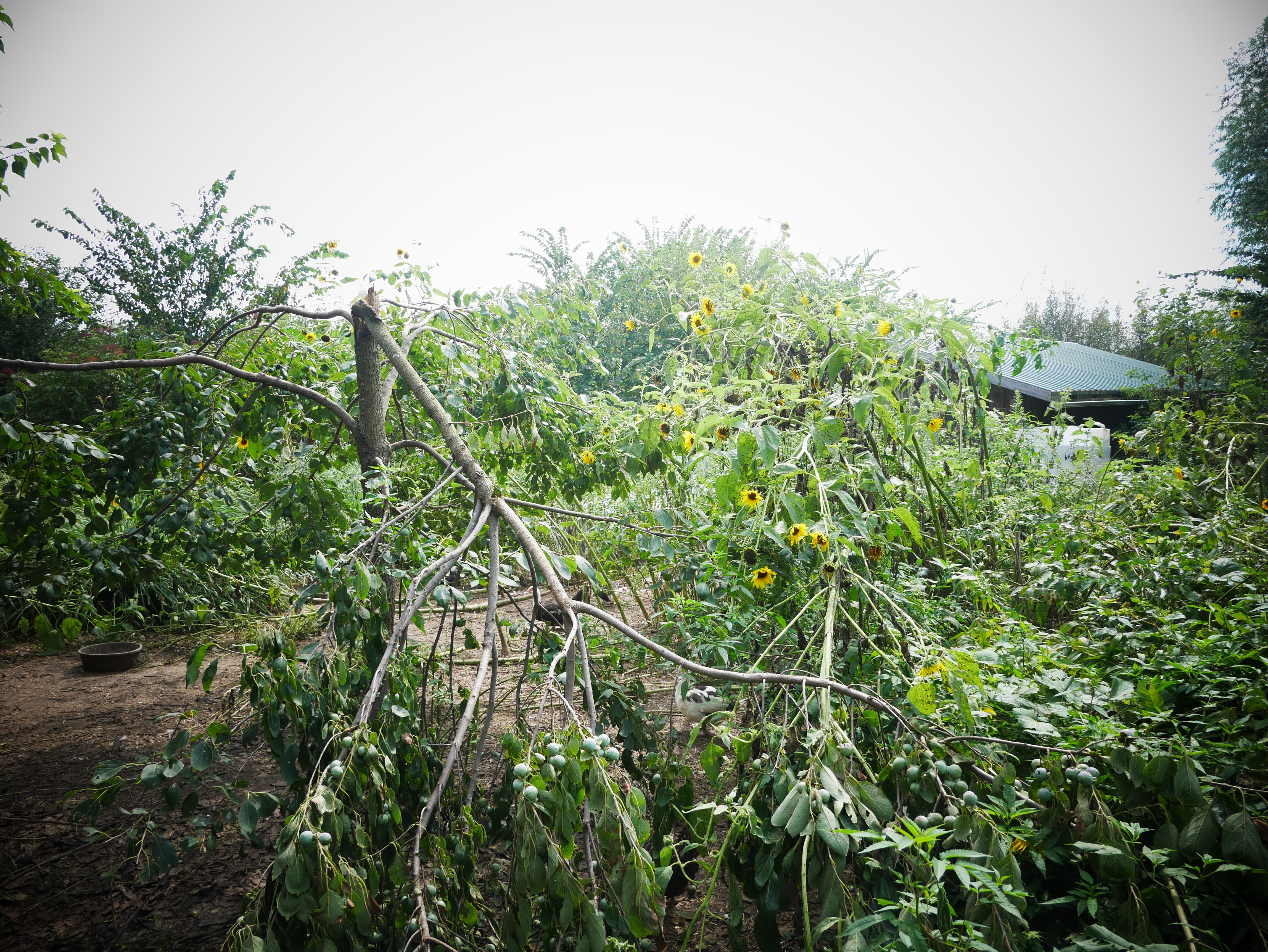
I spent the rest of the morning lopping and hacking pathways through the scratchy tangle of sunflowers that had collapsed across my various foot trails, goat trails, and cart paths. It wasn’t until that afternoon that I discovered my favorite persimmon tree had been scalped of half its crown, a twelve-foot section of trunk laid twisted against itself, the lifeless leaves pressed into mud, the green and aborted fruit pecked and rejected by chickens. This wasn’t just my favorite persimmon tree, but perhaps my favorite tree I’d ever planted myself—a chance seedling that grew rapidly and bore large, slow-ripening persimmons that would hang on to the tree until solstice, like sugary Christmas ornaments. Because it was a popular tree for my chickens to congregate near in the early winter, I named it “Motherclucker”.
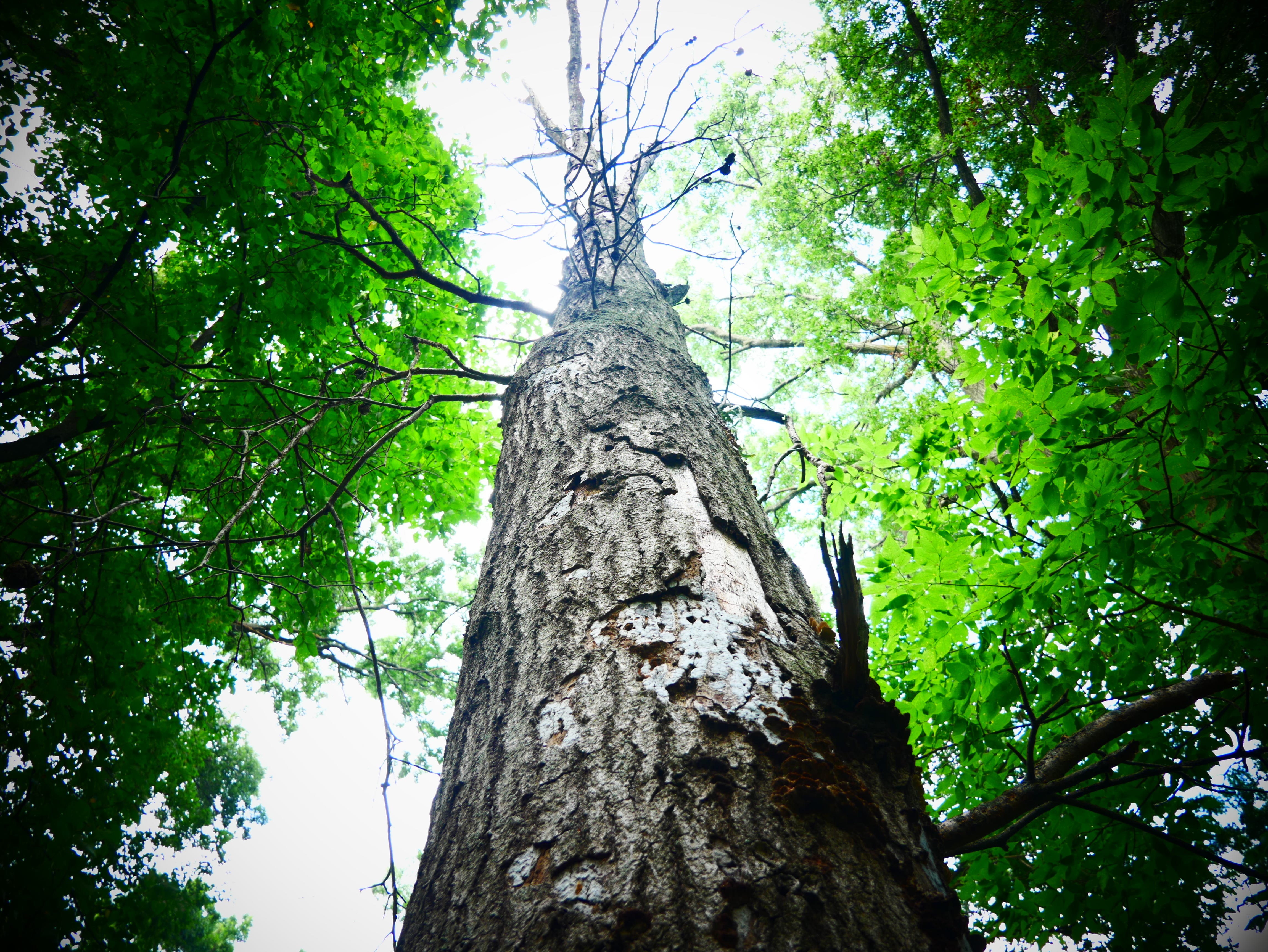
Not too many days before the storms, another tree fell, this time it was one half of a matriarch pin-oak straddling the fenceline between us and our neighbors, a victim of time, successional ecology, and wet, shifting soil. I did not hear it crash, but I saw it soon after—the once springy limbs brittle and cracked and pressed into the mud, the great hollow carcass of its trunk broke open like a dropped melon, the leaves desiccated, the spongy innards of its rotten heartwood spilled in the understory, a new layer of detritus for the hungry woodland soil.
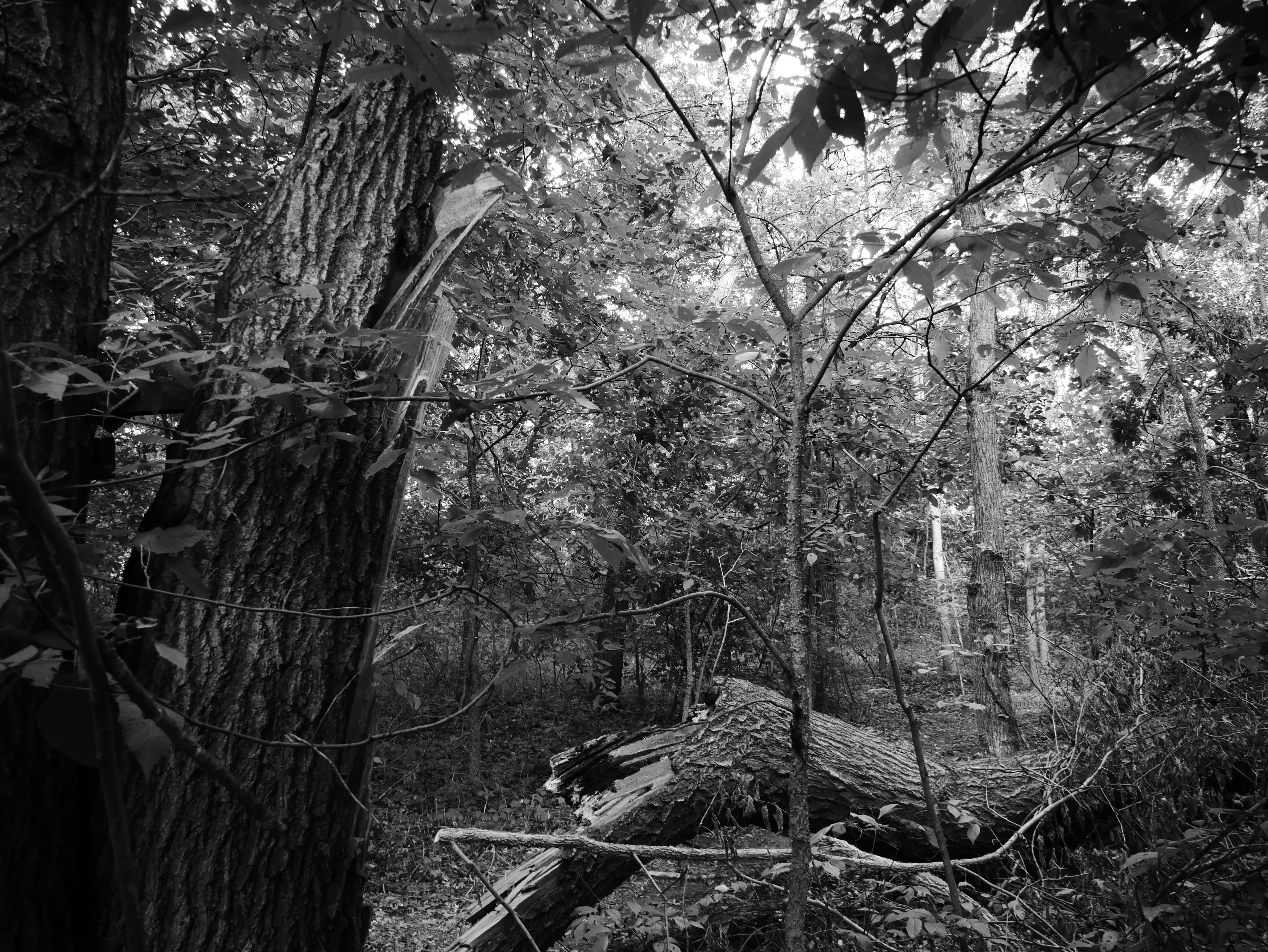
When a tree falls in the woods, many things hear it, even if humans aren’t on the scene to somehow extract materials or profit from it. The crackling of roots, the explosion of rushing leaves and ricocheting twigs, the thunder of broken branches are all heard by deer and squirrels and blue jays and frogs and beetles and carpenter ants, and in many cases, human perception of that level of sudden, violent nutrient exchange wouldn’t add much to the forest’s existence, one way or the other. When a tree falls in the woods, it is just the natural, trophic tilling of a cycle of death, decay, and regeneration, when to human eyes, it might appear as some type of loss. Roots are unearthed, and in the process, the soil takes on a new shape and composition—the fungally assisted soils closest to the roots, fed on a steady diet of exudates move from a lower horizon in the earth to a higher.
The crater itself becomes a new habitat, perhaps filling with spring rains to become an ephemeral breeding site for frogs, if not mosquitoes. The sugars in the wood, brought down to the soil surface feed fungi, and the hollowing trunk itself becomes home to countless creatures. All the insects and arachnids living in the canopy become potential nutrition for ground-dwelling insectivores, and the canopy itself, rich in sugar and nitrogen meets the soil surface and all that thrives just beneath it. All this happens where I human might find chaos, or loss.
I managed to drag off and limb up the first part of Motherclucker’s crown; the browning leaves intermingled with the mud, the fruit wrinkling in the heat, pecked over by curious fowl. I haven’t been able to rouse myself to do the same to the second portion, so it hangs off the top of the remaining trunk like a wilting ladder, fading into the wastes of storm-flattened sunflowers. In traditional island cultures, like Japan, loss isn’t accepted this easily. They have a specific use for every resource, at every stage of ripeness, as people who’ve long reckoned with finite resources in the middle of an isolating, cold ocean.
Kakishibu is a traditional Japanese dye, produced from the fermented fruits of unripe persimmons. The tannin-rich fruits are harvested while green and highly-astringent and covered in water for months or years. They yield a rich, brown dye that has been used for textiles and wood stains. The tannins in kakishibu are not just pretty to look at—they are antifungal and antibacterial by nature, preserving wood and textile from molds, mildews and other kinds of rot. Traditional Japanese culture, particularly in the late Edo period, was built upon a foundation of repair, resourcefulness, and longevity. I’m waiting for our own modern, global culture to see ourselves similarly, as an island in the midst of a cold ocean, with finite access to resources.
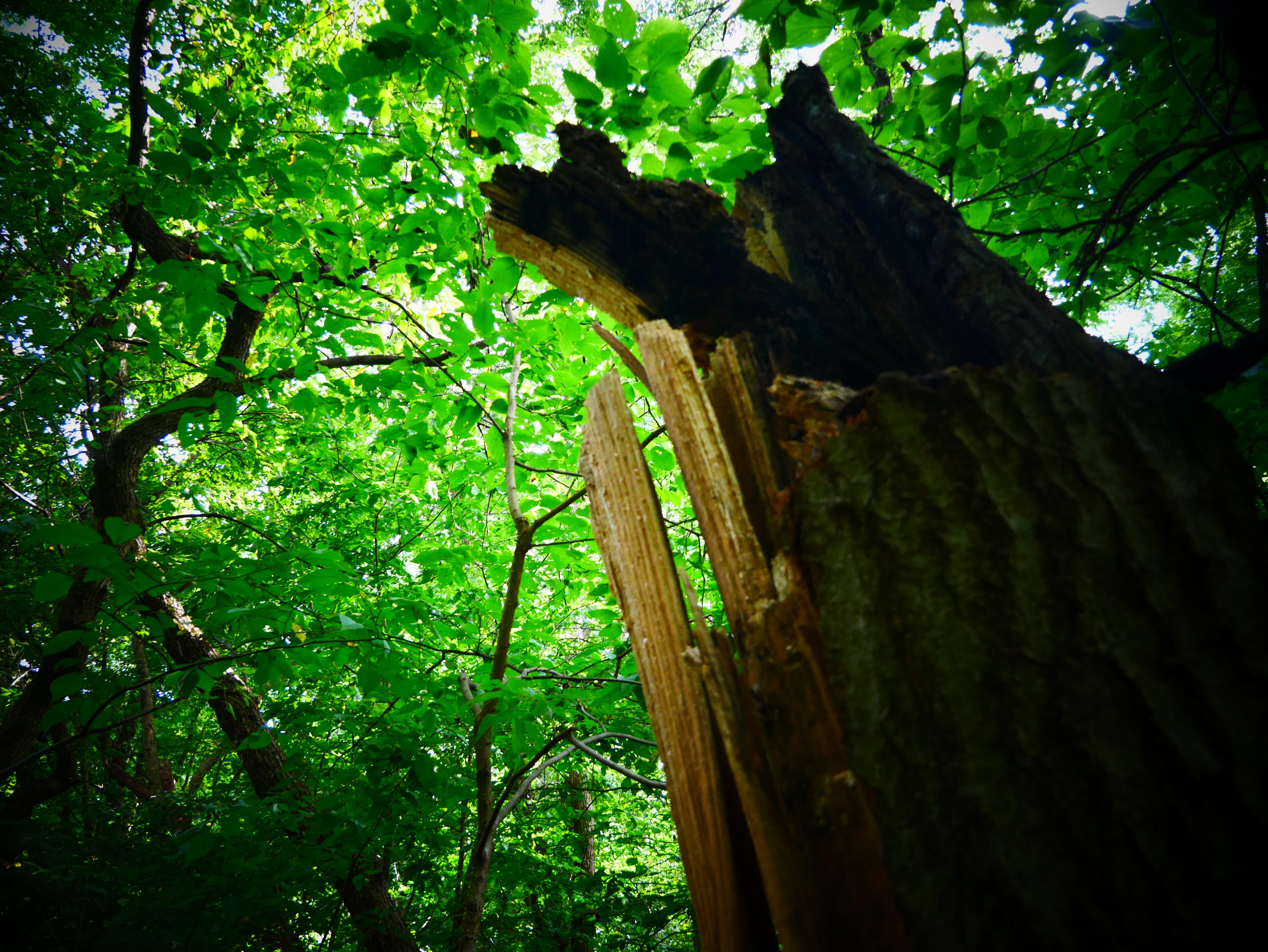
It has been hard for me to adjust to the visual change surrounding the persimmon and the pin oak. The landscape there is altered, overturned. The sun shines with a different quality of light in those places. They somehow feel distinctively different. In the course of any given storm, this must happen everywhere—at least everywhere that humans can feel things. I have lived here long enough to watch whole town squares in dying communities crumble into broken canopies of dusty red brick. I’ve watched hollow barns lay down over the course of a decade, and I’ve watched a regeneration of sorts, mostly comprised of Dollar Generals and vinyl-sided country estates.
In their infinite desire to coin terminology for everything, philosophers have described this sensation of watching negative environmental change as solastalgia—a portmanteau of the Latin word solacium (“comfort” or “solace”) and the Greek root -algia (“pain”, “grief”, or “distress”). Thanks, philosophers. Solastalgia is defined in the present. It is existential anxiety related to the changes we are perceiving right now—storm damage, flood damage, resource extraction, the cancerous growth of plastic bullshit everywhere—as opposed to ecological anxiety, which is the sort of “pre-traumatic stress” related to where this is all heading.
Animals, plants and microbes can certainly feel environmental stress, and often before we do, encased as we are in climate-control. Some of them successfully adapt to it—raccoons make homes in the gutted cadavers of fallen oaks and house sparrows alight in the rafters of Home Depots—but I don’t think any of them would ponder it in the temporal and existential realms if they were granted the abilities to change it for the better. Only human beings, given the choice between thinking and doing, would study and discuss and make art and create careers and industries around their environmental distress without making the effort to directly address it.
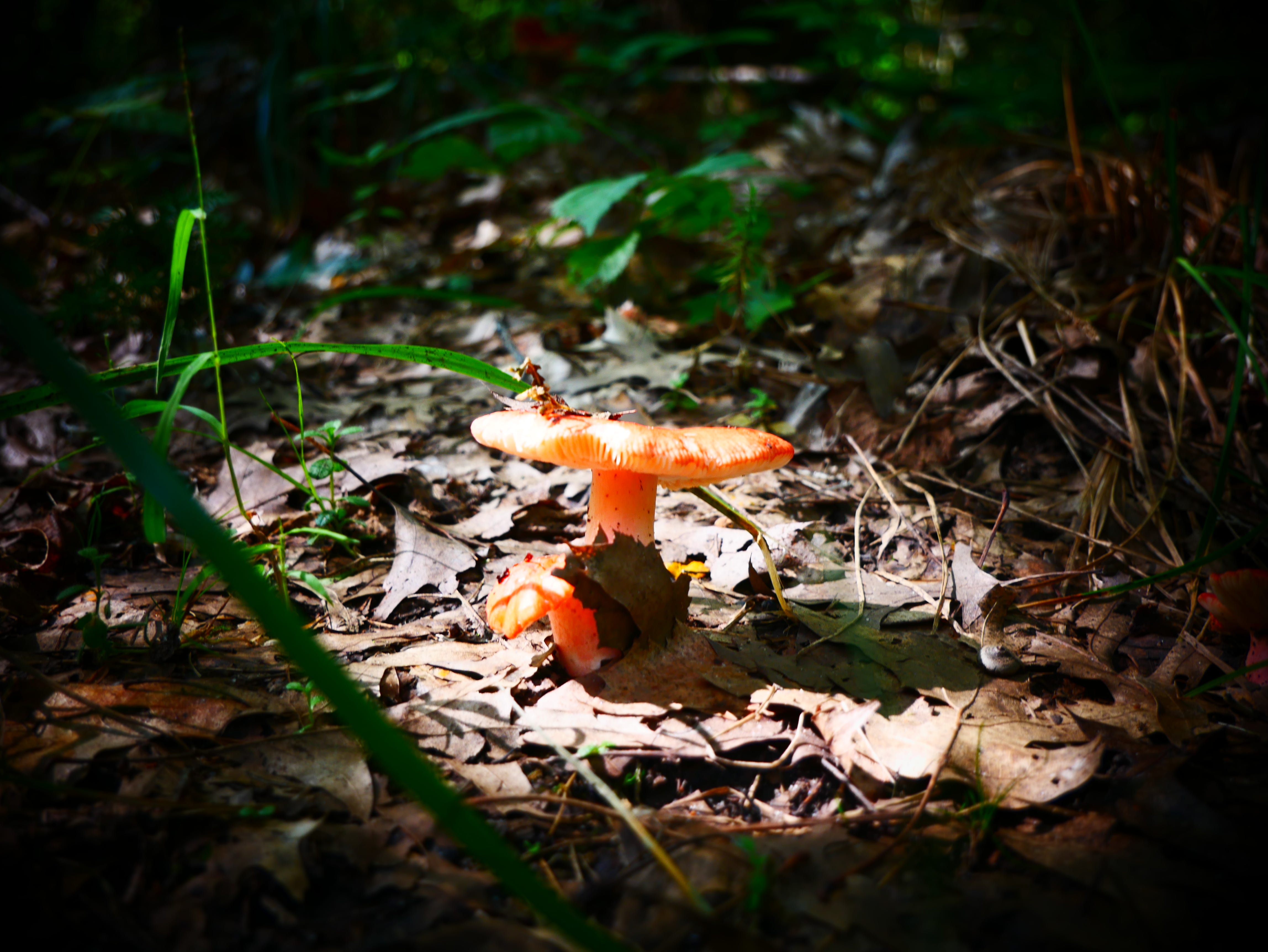
That part where I become a mature orchardist? Well, I’m not sure how big of a deal it really is, and to be clear, I couldn’t say that I’ve gotten any more skilled as a result of it either. But I suppose it was moments after I discovered the second portion of broken persimmon tree, and trying to reckon with how best to surgically alter the jagged break so that it would shed water rather than trap it in the trunk, I flashed back on that chaotic scene along the fenceline, where the old pin oak had finally been cut down by weather and time. A philosopher could coin a term for what I felt, but I’m not sure what the point in that would even be. Let’s just call it some kind of comfort with disturbance, with change—no matter how violent it may be.
If we were to feel every loss, we’d be paralyzed, and in many ways, it seems like we already are. But every shift, every loss, every storm brings with it some pivot to a new possibility. Left to its own devices, a forest does heal. The same is probably true for a lot of places. Where Motherclucker once towered, it stands squat and wide. Chickens roost in its broken crown, and in the spring, it will return to growth, I believe, fed by the sacrifice of its own cracked branches that fade into the landscape under a thin strata of duckshit and disturbed earth. I could be cut down just as easily—we all could. I’d like to think that the utility of this place will extend beyond the limited timespan of our own species, that whether or not a tree falls or a tree stands “unobserved”, the act of placing it there now supersedes our collective inaction. But that only makes me a more mature orchardist, and not a better one.
As an immature orchardist, I’d been trying to create a productive space that operates at a maximum level of abundance, a heightened state of yield, reflecting some larger cultural folly where in life—and even in death—we attempt to achieve some perfected, predictable stasis. We’ve managed to coat the earth in a layer of waste that does not decompose, erect ever-standing monuments to our financial empires from the gutted mines of faraway lands, and impregnate the earth with our own, rot-less corpses, and while my own personal fear of death remains unobserved (at this time), or at least deeply below the surface, watching a few dozen of my own orchard trees succumb to it has felt somehow threatening and painful to who I even am. If only I could think like a frog or a raccoon, and see each new opportunity for action after each wound and scar, I might not only be more mature, but more skilled too.
So I suppose I’ll go gather those unripe persimmons now. I have plenty of buckets of weirdly fermenting things here, a few more won’t hurt. Besides, I could use a few more preservatives in my life. There’s lots I’d like to preserve.
I would be unable to create this work without the material support of readers like y’all! If this essay connected with you in a meaningful way, consider upgrading your subscription, or express your gratitude with a one-time tip. Thanks for reading!
Author’s note: I have been writing a lot lately, mostly for projects that I am contractually obligated to finish by hard deadlines, which hasn’t left me with much time to read or write here. Tempted as I am to apologize, these future projects will eventually trickle back to you, dear reader. Besides, the internet is already chock full of words, and most of them are arranged for the sake of ‘content creation’—it would be a disservice, I think, to write for the sake of algorithmic manipulation. If I’m not inspired, I won’t be publishing.
That said, I know I have to throw folks a bone now and then. I have been conducting some interviews for my first book (being published by Belt Publishing in Fall 2027) which I might publish here for a taste of what’s to come, and after double-checking my contract, I could foresee sharing some of my progress with supporting subscribers.
A more intensive posting schedule will likely resume around October, just in time for the springtime of death.
As a final note, I am electing to not allow my work to be scanned by AI checkers. I’d like to think it’s obvious that I don’t use AI. Scanning another writer’s work feeds their style into the larger data monster, and I consider it a breach of consent, so pretty please, don’t do it. Any bullshit you read in the Fox Holler Almanac is purely of my own concoction.