
Even a Wounded World Feeds Us
Snow-seeding, cold-stratification, and foul-weather farming

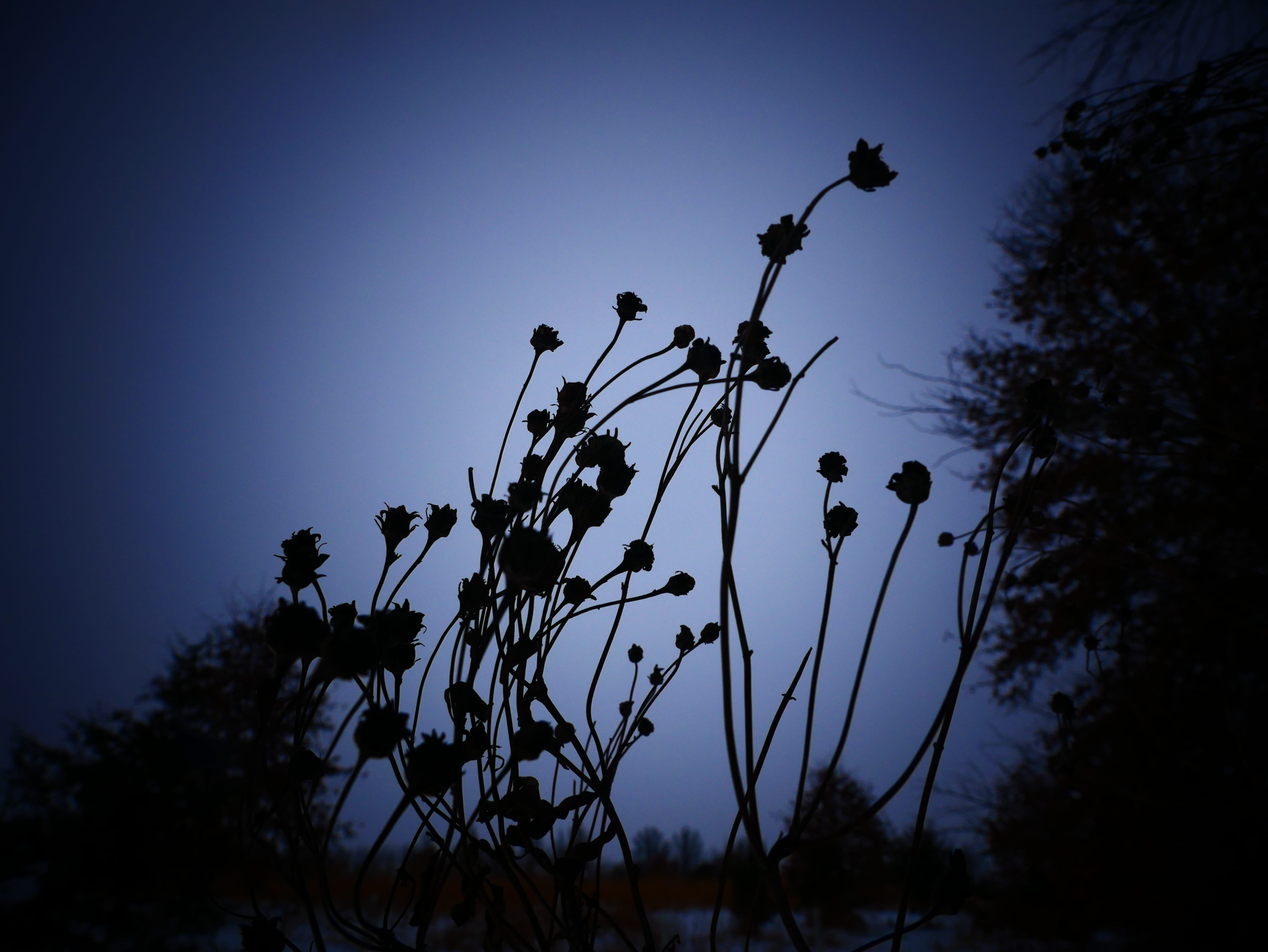
Dry, charcoal stems of last summer’s coneflower rattle in the wind, protruding from the prairie’s snowy crust, a gift of fine, spiny seeds shattered and sprinkled among the sparrow-shit and small tracks of flitting, foraging birds that gradually fill with the next of round of flakes. From the icy gravel road running along this slope that serves in the transportation of millions of calories in the form of live, trailered beef cattle, and grain wagons overwhelmed and bulging with golden corn kernels, our prairie pastures might appear barren of food value, especially now, in the whipping wind and deepening snow. But each stem and spire of grass contains a cache of seeds; every clump of brush some freeze-dried fruit or leafy frozen fodder, suspended above the tundra for alighting cedar waxwings, or wandering turkeys. With the earth robed in ice, all that remains to eat is that which has escaped the smothering snows— the seedheads of later flowering prairie plants. Even a world that appears barren will feed us, if we get to know it up close.
I’m fine with the snow. Just fine. Not particularly happy about it, but appreciative enough for the necessary moisture and ample tracking and bird-watching opportunities. As my body begins to weather –advancing as I am into the middle act of my remaining time– I find my once-invigorating winter tasks to be more like drudgery. A day of clearing heavy, wet snow from greenhouses, solar panels, and pathways leaves me sore and exhausted. The novelty of hauling hay and grain and jugs of water on sleds down icy paths has worn away this past decade, along with my flexibility. Sometimes, I dare say, I even feel a little winded.
The row-crop farmers who barrel down these roads with their overflowing wagons will often spend winters down in Florida— at least that’s how it used to be. With commodity prices veering towards the marginal while equipment and input prices continue to climb in a world of increasing instability, there are very few row-crop farmers in our our area who only raise row-crops anymore. As land ownership in our region transitions away from old-timer “English” farmers and toward Mennonite and Amish growers who tend towards a more diversified farming scheme, there’s fewer snow-bird farmers in Northeast Missouri. I, for one, am all for it.
The project of land stewardship is not one for the jet-set. Stewardship, at its core, is the application of feedback one receives from spending complete cycles of seasons in one place. It requires that the steward experience more than a growing season, but those subsequent days of hunger, exhaustion, and barren drudgery. Anything else is fair weather farming, and probably soon-to-be-replaced by precision ag tech from my nightmares, at least in those places geographically suited towards GPS-guided self-driving planters and harvesters.
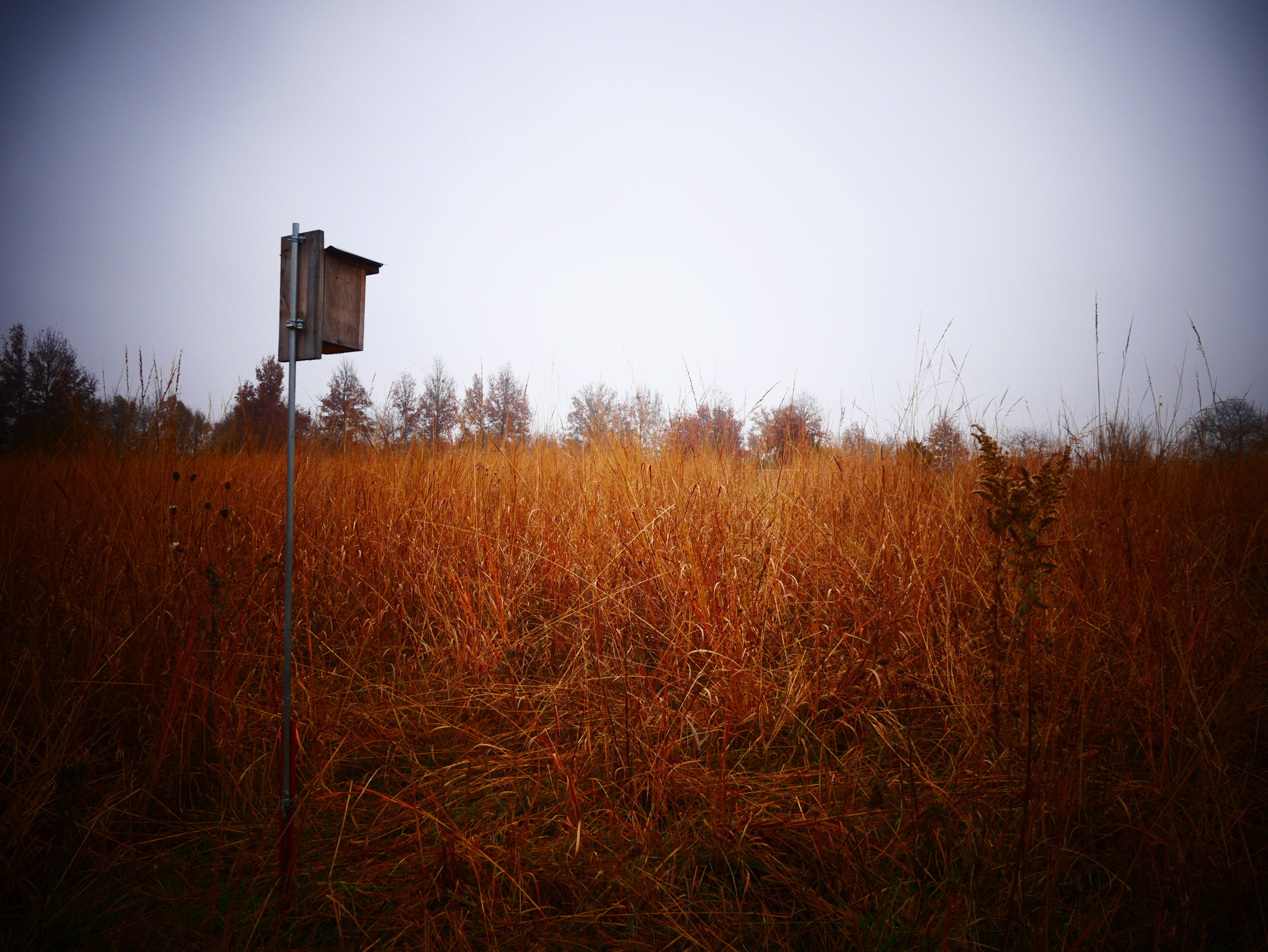
Prairies like this one, as barren as they may appear, feed a vibrant if unseen network of living things year round. Living roots feed pudgy voles snatched by careening owls. The gems of prairie seeds cling to wind-battered stems for fidgeting flocks of white-throated sparrows. Gangs of dark-eyed juncos flit through the fresh plops of cow-pie for pre-digested bits of hay and grain. Cottontails dance from bramble to briar, evading foxes and coyotes, and foxes and coyotes will still find plenty of cottontails out in the brush some of my fair weather farming neighbors scoff at. Even without autonomous tractors or a personalized AI agronomist, this prairie works year round to feed something— which cannot be said for the vast, plow-gutted bottomlands of rootless, mineral earth, impregnated with plastic drainage, the great, humid deserts of the Midwest which hold no life for half the year, and an extractive crop of considerable expense and minimal dinner-table value the other half.
I can’t say for sure if I am a “good” steward of this place. I have, however, struggled against it enough, been caught in the thorns and dragged through the mire enough to have received some amount of applicable feedback. I leave some seedy thatch for the birds. I burn the woods to make way for new seed in the winter, after the frogs have grown quiet and the salamanders have returned to the cool, safe mud. I herd the pigs quickly through the woods, and only when they are dry or frozen, fattening them on surplus mast while leaving ample acorns for the squirrels and jays. I see every patch of thin or overgrazed vegetation as an opportunity for me to add a diverse mix of seeds— if I don’t do it, less desirable or even invasive species are liable to show up. I traverse the rolling slopes in winding, staggering patterns to avoid rutting and erosion. I thin the woods with an abundance of forethought and conviction. I would be unable to do this if my farming was performed with an app connected to a satellite connected to a tractor, let alone from Florida.
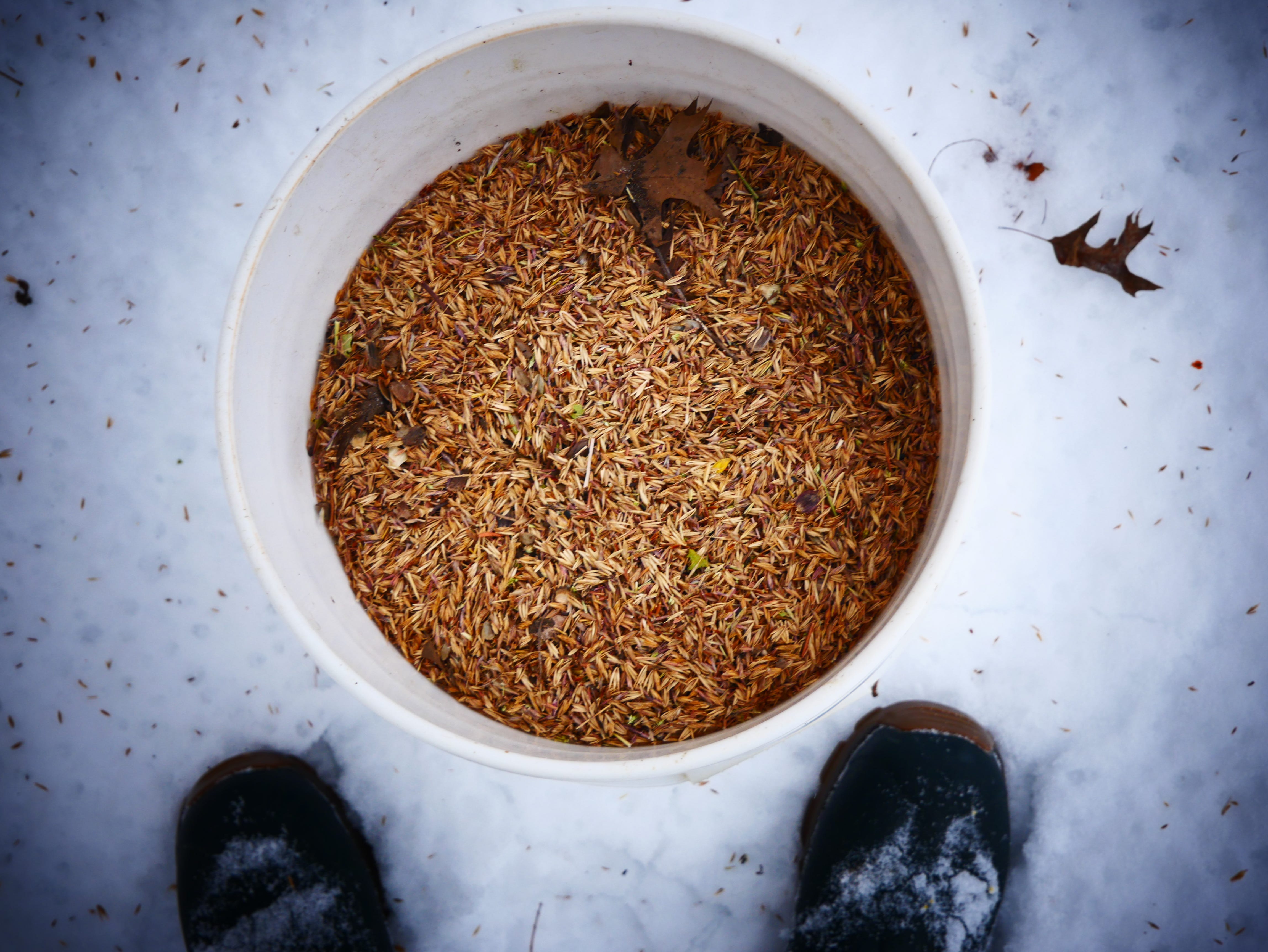
Today is a good opportunity to sow seed— specifically, prairie seed. Most prairie forbs, and some grasses as well, need a period of cold stratification to trigger germination on the other side of winter. Without preparing a seedbed the conventional way, which is some combination of tillage and harrowing, I am left to experiment with alternatives: fire, livestock disturbance, and snow-seeding.
The seed mix in question is very special: a mix of native grasses and forbs (mixed warm-season and cool season) with some degree of partial-shade tolerance and nutritional value for livestock, meaning adequate protein. This is the first batch of this experimental mix that Hoksey Native Seeds helped me put together, listed below by Scientific and Common name:
Elymus virginicus- Virginia Wildrye, Bromus kalmii- Arctic Brome, Elymus villosus- Hairy Wildrye, Carex molesta- Troublesome Sedge, Carex brevior- Prairie Oval Sedge, Andropogon gerardii- Big Bluestem, Schizachyrium scoparium- Little Bluestem, Sorghastrum nutans- Indiangrass, Bouteloua curtipendula- Sideoats Grama, Zizia aurea- Golden Alexander’s, Desmanthus illinoensis- Illinois Bundle Flower, Desmodium illinoense- Illinois Ticktrefoil, Helianthus maximiliani- Maximilian’s Sunflower, Desmodium canadense- Showy Ticktrefoil, Silphium perfoliatum- Cup Plant, Silphium laciniatum- Compass Plant, Chamaecrista fasciculata- Partridge Pea, Heliopsis helianthoides- Oxeye, False Sunflower, Helianthus grosseserratus- Saw-tooth Sunflower, Coreopsis palmata- Prairie Coreopsis, Dalea candida- White Prairie Clover, Oligoneuron rigidum- Stiff Goldenrod, Rudbeckia hirta- Black-eyed Susan.
These seeds will perform a variety of functions– while our primary economic concern is that they provide some degree of palatable nutrition for our cows and goats and even turkeys, our animals will likely graze each patch of plants for no more than a week or two out of the year. The other 350 odd days, it will become native cover that provides nourishment, shelter, and pollen for insects, birds and other animals. While timothy and clover will give the kind of tonnage livestock need to thrive, these unique native plants are being seeded into woodland-edge areas that we can emergency graze our livestock in during excessive heat and sun. And so, adapted native forage can offer some degree of nutrition in the shade of trees… many of which also provide additional forage value on account of leaves, shoots, and stem-tips. Mulberry and Osage orange are particularly nutritious, as noted over and over again, in this Almanac. Another key component of my gambit here is that animals in general, and ruminating livestock specifically, do not perform well, metabolically speaking, under heat stress. In pure agronomic terms, these native seeds do not provide as much feed-value per acre, but the dappled shade they’ll be grazed in is overall more beneficial than having hot cows in a field of “high value” forage they are too stressed to digest.
The native cool-season grasses will push their way through the winter leaf litter in earliest spring to provide a quick burst of vegetation in the shelter of old-hedgerows, gradually supplanted by robust, heat-tolerant warm-season grasses as the summer wears on. The fleshy, palatable leaves of saw-tooth sunflower and black-eyed susan, complimented by the protein-rich tangles of desmodium and bundleflower will offer a diverse mosaic of nutritive qualities for livestock and wildlife alike in the doldrums of summer. And in deepest winter, as the snow settles in icy strata out and along our “barren” and brushy fields, juncos and sparrows and finches will flit from stem to desiccated stem, reaping rich seed from the fallow pastures, perhaps dropping a few along the hundreds of miles of barbed wire that hems in this patchwork of Northeast Missouri hardpan… at least until the hedgerows are plowed for the benefit of driverless tractors urging ever more caloric monoculture out from the thinning earth. We aren’t just feeding livestock, we’re feeding native bees, threatened butterflies, and dozens of birds species at risk of habitat loss.
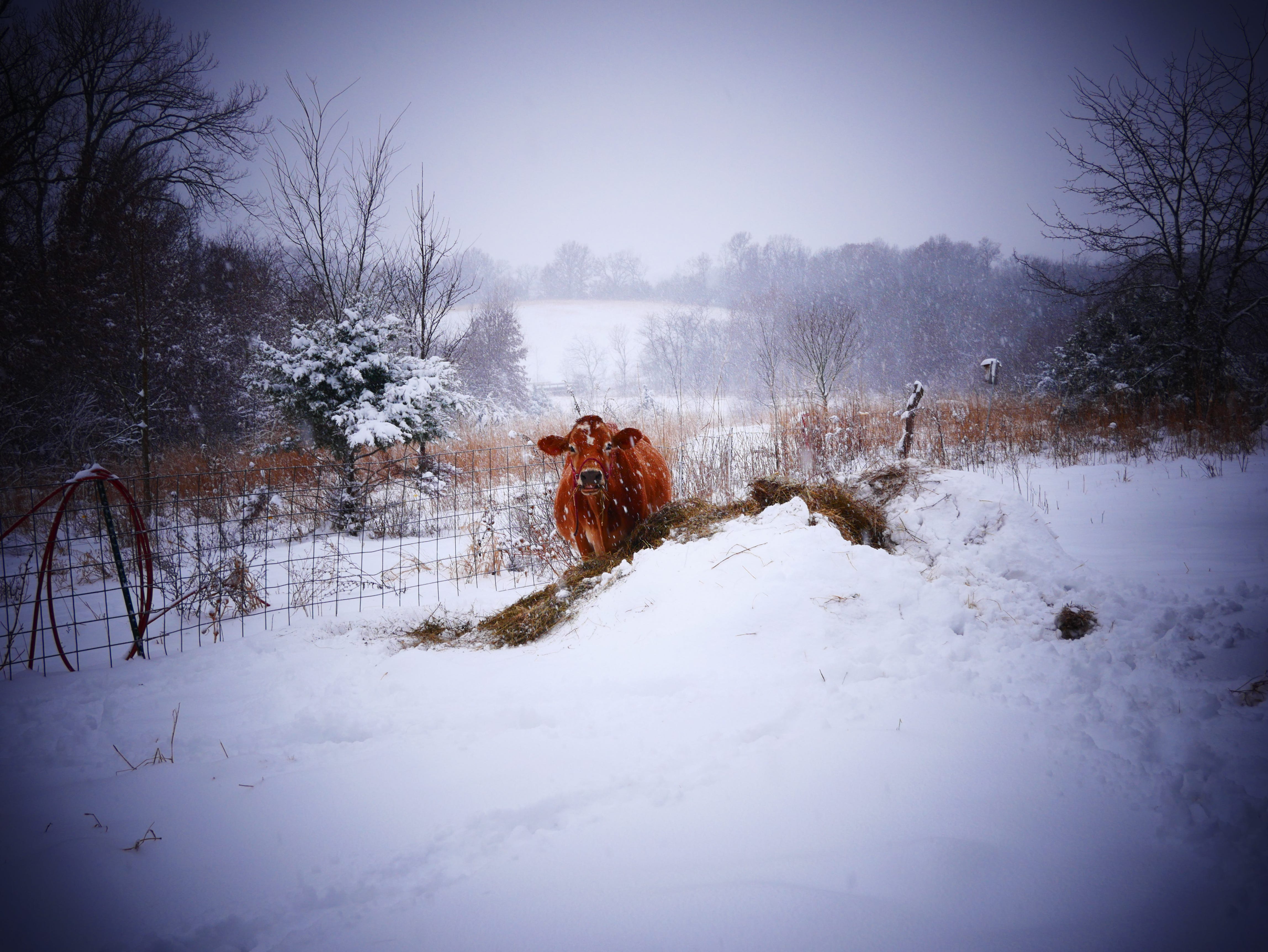
For something that was once plentiful and common here, this seed isn’t cheap. Anyone in the native seed business will tell you that the level of specialization required to produce it, from equipment to maintenance to labor, necessitates a high initial cost. But, as adapted perennial plants, a thoughtful and successfully executed plan for establishment pays off over the coming decades. Developing that plan takes experience, observation, feedback, and a fair bit of winter drudgery. I have the latter part down pat.
In their original ecological context, these seeds would have made it to the soil by a few different mechanisms. Many of them, like the desmodiums, are sticky, and manage to work their way into animal fur, to subsequently be scratched off in bare dirt wallows or along tree trunks and thickened thatch. Fires would clear the ground as a seed bed, the more low intensity ones also singeing the stems of these plants, allowing the unscorched seedheads to drop in place. Herds of bison and elk, or in my case, cattle and goats, might trample ripened seed into the moist soil during periods of dense grazing and browsing. And in the snowy season, exposed seeds would be spread by wild birds or small mammals, dissolved into the ever growing strata of snow to be tempered by ice and gradually pulled into the freezing, thawing cracks of the dormant soil.
We can simulate these natural modes of dissemination by using fire, livestock trampling, grazing, and a good sense of timing. And while my seed project, yet the latest in a series of Jack-and-the-beanstalk-style magic bean schemes I’ve gotten involved with in the past few years, is unlikely to be 100 percent successful, I have thrown a diverse amount of high-potential genetic material at a dynamic variety of landforms with a fair bit of care, observation, and conviction. If I yield nothin else, I’ll have some baseline data of what establishes best under the wide variety of conditions I’ve applied the magic mix to.
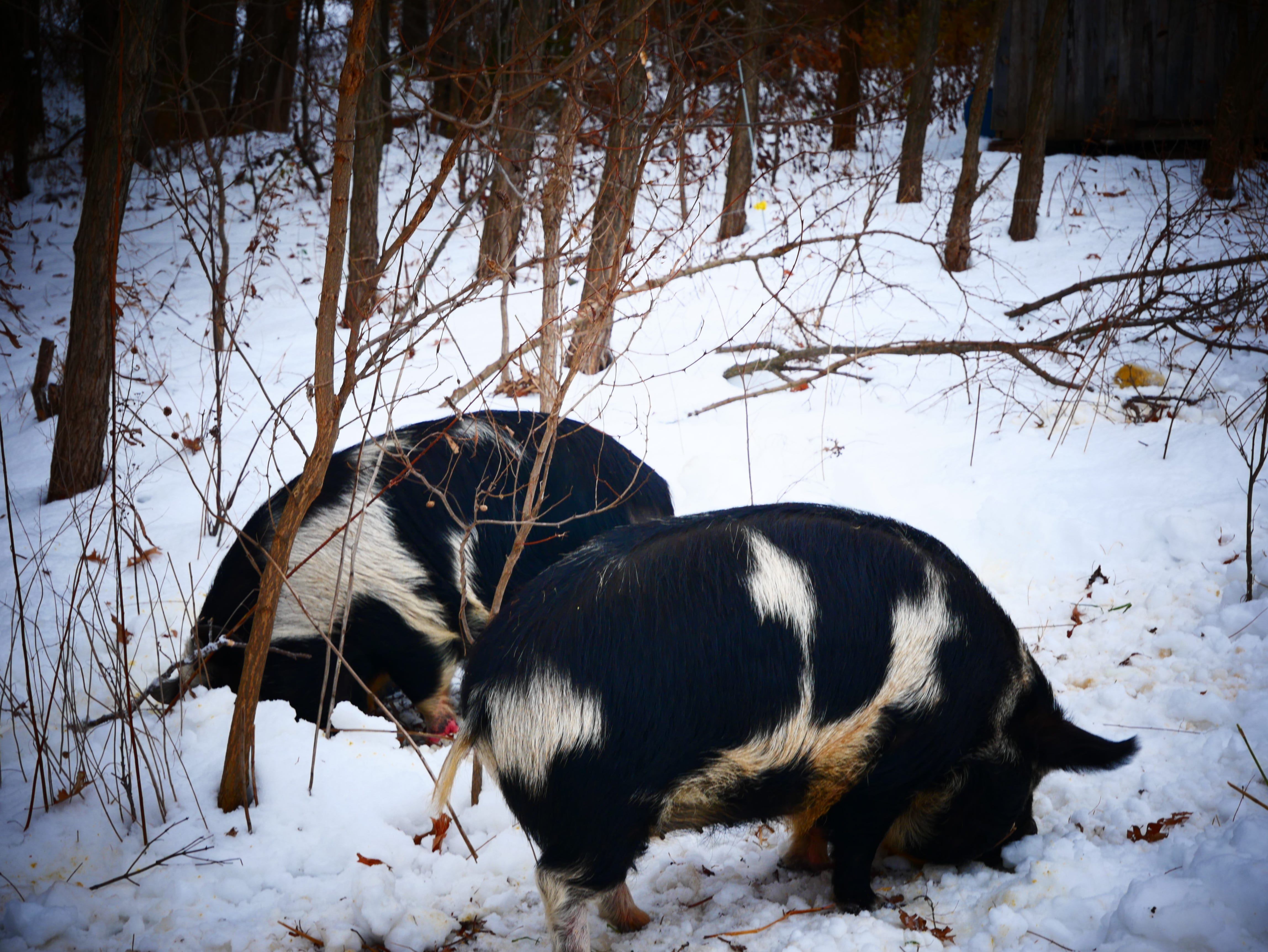
In areas I cover cropped in sorghum/sudangrass, we threw seeds before scything the cover down. We also played around with a “human-scale” roller crimper– two people trampling the cover crop down over the scattered seed with a big board. We’ve also burnt some woodlands, using rakes and leaf-blowers to eliminate leaves, twigs, and brushy growth, allowing for direct seed-to-soil contact right before the first round of snow. Today, I am sowing seed into the falling snow out among a grove of pin-oaks where one of my swine herds is trampling about, snuffling for acorns and kicking over the leafy duff. In all, I’ve sown about 2 acres of land to this diverse mix in the past week. Now, I just need to wait four or five months to see the results. Ecological repair is not a practice for the instant gratification crowd.
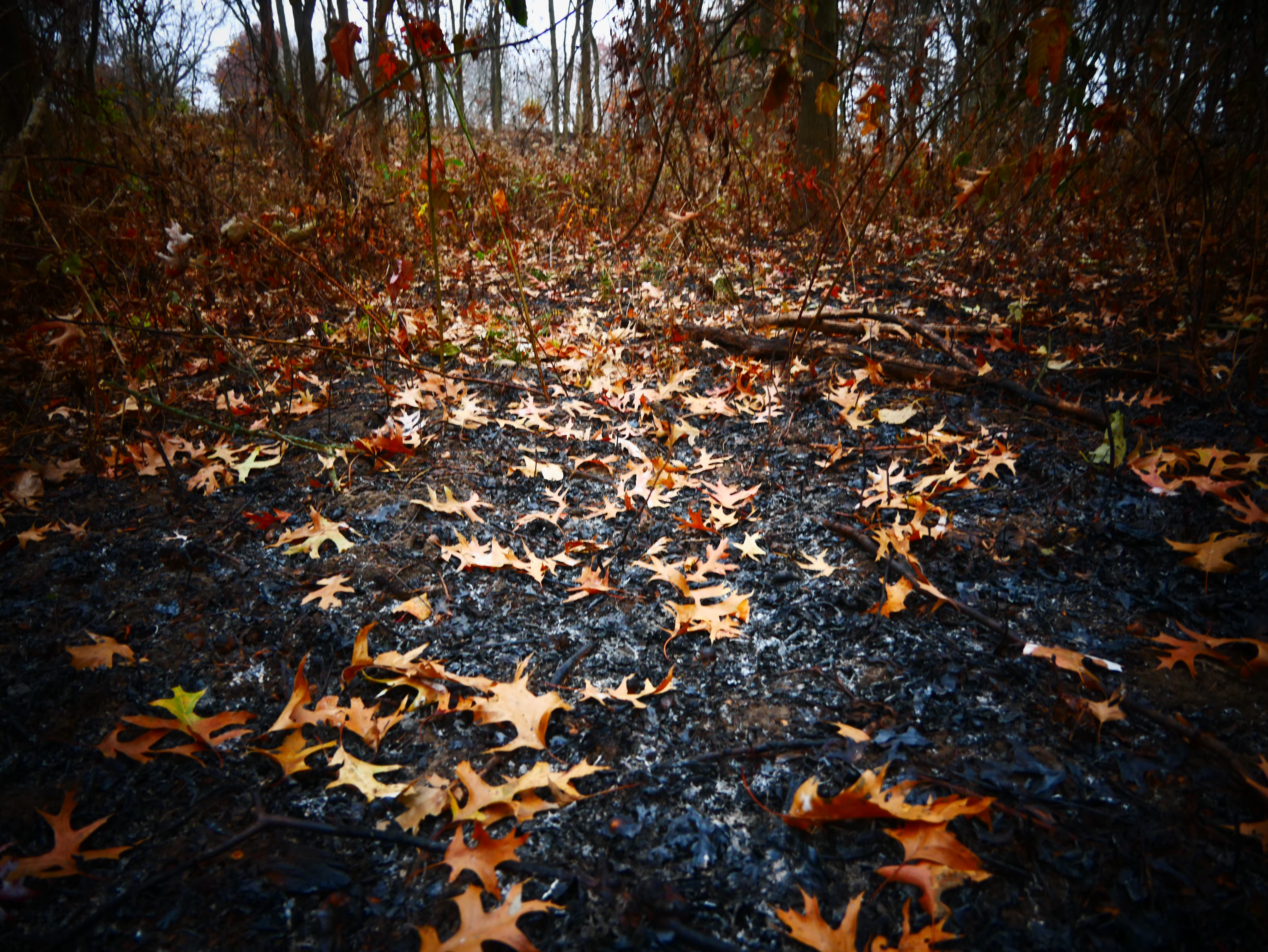
The snow-bird farmers aren’t snow-birding as much this year. In part, there’s fewer of them, and those with all their chips in annual row-crops aren’t exactly laughing all the way to the farm loan office anymore. Also, no one expects to have this much snow this early in the season– this current storm arrived three or four weeks ahead of when we’d expect to see it. And so, they sit in the cafe, hands clasped or hung around over-all straps, the price of donuts increasing like the price of anhydrous ammonia, staring out into the blanket of white that gradually fills in over the rough, plow-broke ground that rests lifeless until the next planting. If there is a next planting. On occasion, the acres of rootless earth might host a wake of bald eagles, tearing into the red flesh of roadkilled deer, or waddling gaggles of white-fronted geese, dabbling through the pulverized earth for spilled corn. Mostly, they sit in silence, the farmers in their slushy boots with styrofoam cup coffee, the fields barren of all but snow and wind.
From the attic window near which I write in the winter, I can see a full-time resident white-crowned sparrow, conspicuous among the drab house sparrows that huddle under the eaves of our farmstand. He ventures out, along with a few cardinals and juncos, to peck and flit in the shelter of hazel stems, spreading the crumbled crowns of coneflower into spiraling trails of seed and chaff, fading under consistent snow.
The rhythm of winter chores is at times halting and exhausting. Our second-hand hoop house frame has a concerning bend in one of the steel braces, and in order to keep it from collapsing, I need to occasionally use a ten-foot wooden stick with a board nailed to the end as giant snow remover. It takes about 15 minutes to clear, and my shoulders remain dropped from overuse the rest of the day. Walking from paddock to paddock can be tiring in six inches of snow, but I haven’t prepared the barnyard for pigs yet, thinking we had a few more weeks, and so with sled in tow, I shuffle through the hardened drifts, hauling water and flinging my magic seeds, directing the slumbering hogs over the vanishing trail towards feeders full of grain, so they might trample next year’s grasses and forbs into the frozen duff.
We haven’t seen sun in days, and to maintain enough power to cook by LED lamps tonight, I frequently must tromp up to the solar panel on our roof and push off the thickening carpet of snow. Then, I trudge to the logpile, pick out a good-sized two-hour chunk of oak, carefully stomp my boots clean before entering our humble cabin, and try and decide if there’s enough time to write between now and the next time I need to check for eggs before they freeze, or bed down the pigs, or break ice on the cow waterer. I’ll spare you details from my morning foray into the snow-dusted outhouse for now, but it suffices to say that the experience is seldom an act of pleasure or enjoyment. This isn’t fair weather farming, but without the struggle, the feedback, I wouldn’t know how to care for this place.
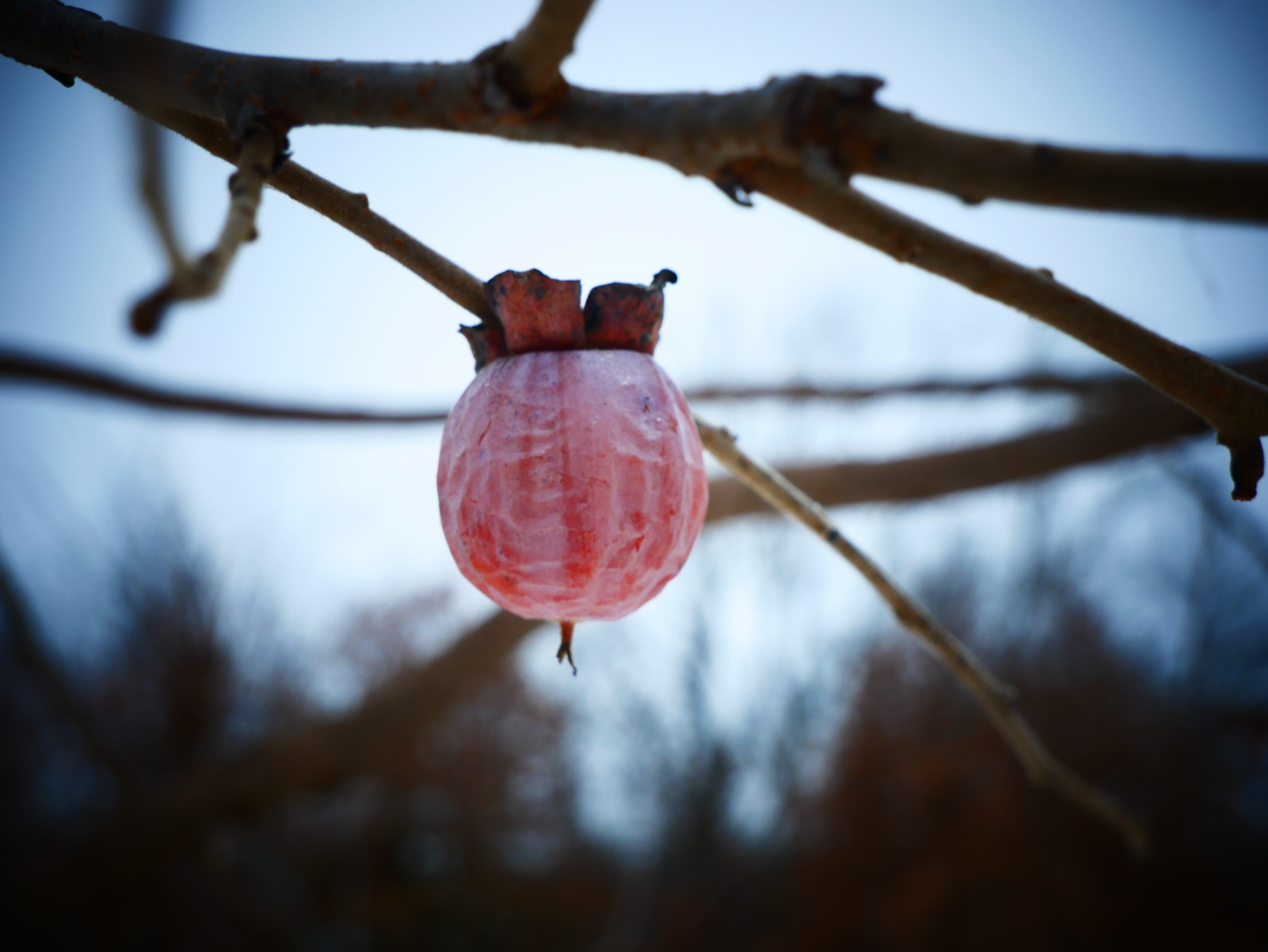
Where the wooded edges are now cloaked in snow, they will eventually burst with flowers and bees and contented cattle. Trudging down to the hogs, I pass by a very conspicuous persimmon tree, entirely leafless, yet still bearing pendulous orbs of sugary orange fruits. They are fairly frozen but not rock hard, the consistency of snow; I fit two in my mouth, spitting their seeds strategically along the path where I scatter handfuls of my magic mix, feeding the future as best as I can fathom.
Across the road at the neighboring feedlot, groups of bellowing cattle push their hooves through filthy snow, nosing through fat bales of timothy and clover, their faces speckled with chaff and seed. Out on the edge of the lot, where the unmown margin meets the dirty slush of tire tracks, I spit a couple persimmon seeds for good measure. Even a wounded world can feed us, if we throw enough seed at it.
The Fox Holler Almanac is a reader-supported publication— I couldn’t do it without you! Share or leave a comment if you liked it. Hell, leave a comment if you didn’t, though I might ignore it. And if you feel moved and able to materially support my work, upgrade your subscription or buy me a coffee. Thanks, y’all.
PS: It’s been a busy and unpredictable season thus far. This current edition of the almanac is coming to you later than planned because I spent the better part of a week working on this piece in Civil Eats. Feel free to check it out. Also, I really enjoyed working on this seed mix with Hoksey. Very thoughtful, conservation-focused folks. If you ever need something to listen to while you’re throwing hundreds of dollars of seed into the snow with your fingers crossed, I recommend giving their podcast a listen, especially if you’re in the Midwest. Also, holler at me if you want a specific breakdown of the “magic mix”… seeds per square foot, quantity by volume, etc….
Yes, yes, YES! I'm here in California where our dormant season is the long dry summer rather than the frozen solid winter. The details are different, but the answers are the same. Plant seeds, pay attention, and embrace it all.
Can’t wait to see what spring brings you!! It’s been such an early winter.