
Stepping In It
Sugar, shit, and stains

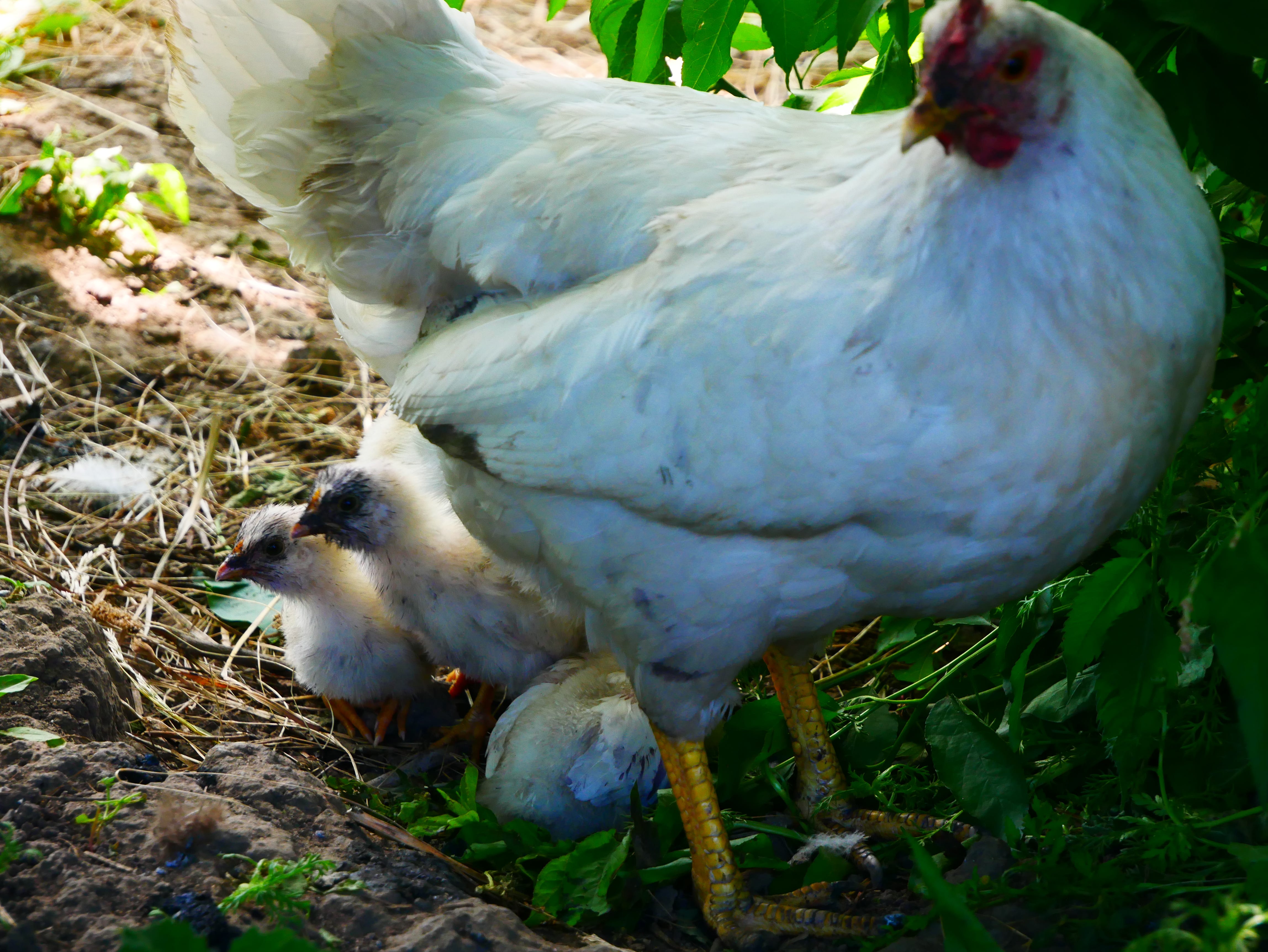
I have spent the past week or so stepping in mulberry shit. And by shit, I do mean shit: inky, purple bird droppings, studded with fine, pale seeds, jewelling the walking paths out along the old hedgerows and timbered draws where I heave carts of sprouted grains and sloshing whey out to flapping gangs of pastured poultry. Overhead, fat robins peck and gulp at the glut of fruit, absconding with their juicy quarry, their beaks stained black, always flapping, always shitting.
In recent days, I’ve done my best to tidy up the farm, while I wait for rain. I’m hosting a farmer field day, my first ever, in which two dozen strangers with preferences and opinions will allegedly learn from me how and why I use trees to support “resilient” agriculture, and the footpaths I’ve carefully mowed for the occasion are freckled with the bloody pomace of mulberry-infused poultry shit, throbbing plops of it, shimmering with worms and slugs and maggots. It isn’t a tidy place to walk, and in the violent heat and ungiving clouds, our forages look particularly poor this spring. Truth is, I don’t care about aesthetics, and I don’t even care about how “resilient” mulberries are when it seems likely we’re all going to drown, burn, or starve in the next three decades. I’ll take sweetness over resilience.
Assemblies of clouds pile into towers on the horizon, but after a whimper of a few raindrops, the sun breaks them. The squash-vines in our garden remain wilted, one row down from the sun-scalded peppers, but the canopy flaps, glossy-leaved and resplendent in the hot wind. This fenceline was planted to mulberry by perching birds, with seed-laden droppings, the trees undeterred by ax or saw or herbicide. The chickens spend their first half of June here, watching for sweet bloody rain.
Some say to plant a tree is to hope, but I’ve largely been doing it out of stubbornness. To plant a tree that won’t bear for two decades is optimistic in a month with no rain, when the forecast keeps backing off of precipitation and the sun hammers the gravel and simmers the dust. I’m neither hopeful nor optimistic this season, but I am maintaining my stubbornness.
We’ve been down in the bottomlands a bit this past week, transplanting pecan and hickory into dry earth. We work down there in the afternoon, when the air is hot but the western sun is partly blocked by hulking sycamores and nodding, twisted limbs of Osage orange. An investment of sorts is being made there, down among the waist-high grass, the borer-killed ash, and the hordes of questing ticks, laying in wait.
Among the splots of berry-shit knitted into the grass that refuses to grow in this odd, early heat, gnats and flies hover in the haze and rot. In the lengthening tree-shade of evening, congregations of slugs and nectar-drunk moths suck at the seedy shit. My irrigation tanks are running low, the viscous flow of green water and larvae barely tumbling out into buckets I carry out to seedlings. Drink it and like it; you were born into a hard, hot world.
So here I am, with ticks crawling up my legs, planting pecans in hopes that they’ll provide something to someone in a parched future. But looking a quarter-century ahead right now feels heavy. It’s better to just take what the hilltop gives me, and pick mulberries.
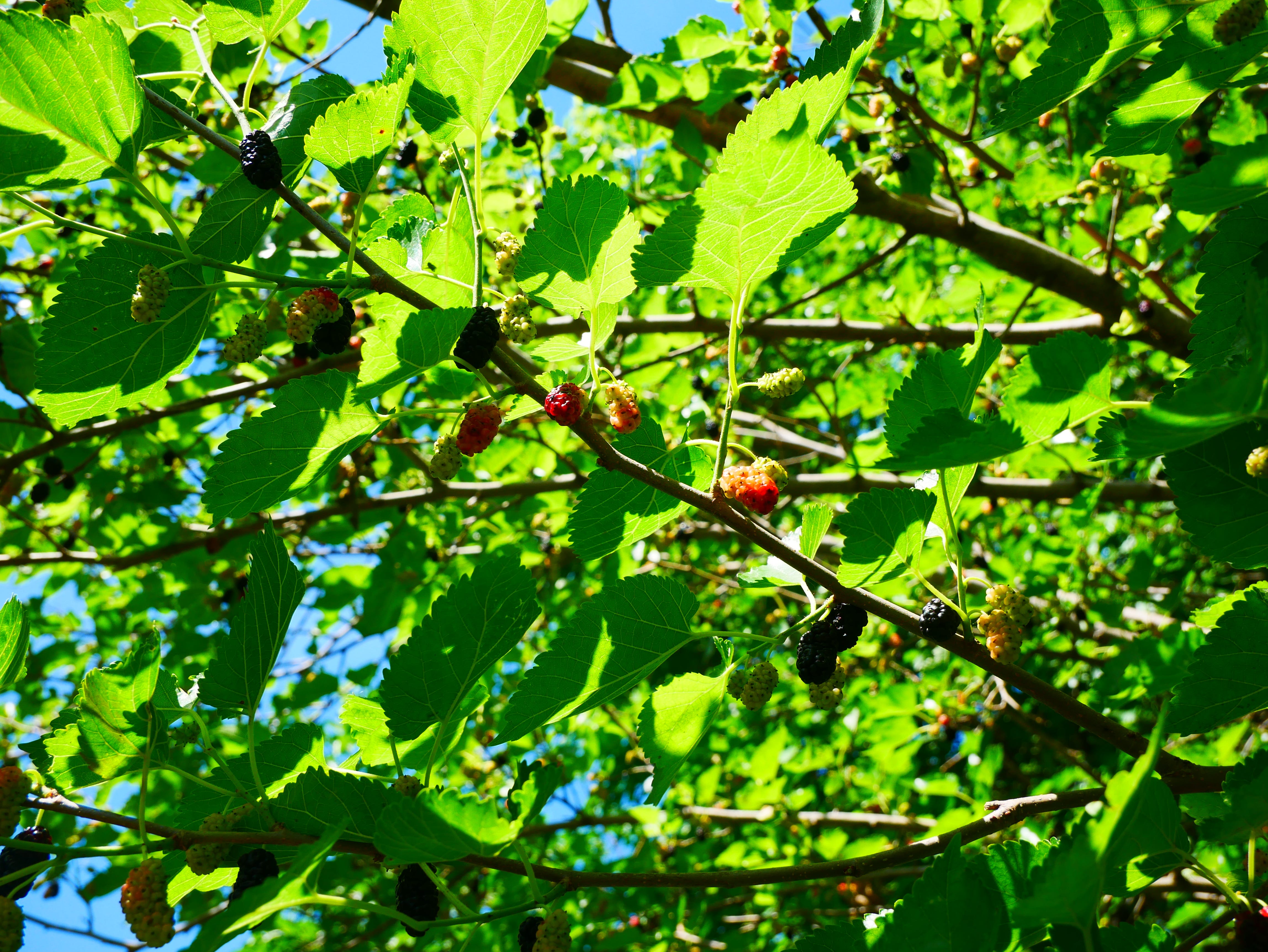
Here in the Midwest, we have two, maybe two and a half types of mulberry. Our native species, Morus rubra (the Red Mulberry), is less common than it once was. Morus alba (the White Mulberry) was brought to North America by colonists to develop a domestic silk industry. Silk never really caught on, but the white and red mulberries readily interbreed to produce a hybrid, which really ought to be called a Pink Mulberry—though I’m not in charge of scientific classifications. None of these ordered distinctions have bearing on the actual color of the ripe fruits. Most mulberries ripen to a deep maroon, some of them a pale gold tinged with lavender. Eat too many unripe ones, and you will get a bellyache.
Often the fruits taste very good. Occasionally, they taste insipid, with a hint of dirt. They seem sweeter when it’s dry though. The mulberry tree is dioecious, meaning individuals have either male or female reproductive organs. The females produce fruit and the males produce pollen. Both have leaves that are extremely rich in protein, palatable to animals and less picky humans. The leaves are used in some Korean cuisine, even being cooked into a tofu-like curd. Whether for human or livestock fodder, the mulberry’s long history of cultivation for leaf production has led to coppicability.
All mulberries readily coppice. A coppicing tree is one which can be repeatedly cut to the base to stimulate vivacious branch growth, like the mythological Hydra. Supercharged by a stubborn and disproportionately large root system, coppiced mulberries can produce luxurious leaf growth, with some cultivars’ leaves getting to be dinner plate-sized. They are nutritionally the same as alfalfa, and far more adapted to poor, eroded soils and climate extremes. Here in the Midwest, I tend to coppice or pollard mulberries every other year, but I’m soft on some of the trees, allowing them to become unmanaged grotesqueries. I’ve even experimented with hand-stripping the fresh green leaves into a bucket, incorporating them into goat, swine, and poultry feed. The hogs and hens prefer the fruits though.
The mulberry has been in cultivation for some 7,000 years, widely considered to be the first agroforestry crop. King James did his best to impose sericulture (silk farming) on the Virginia and Georgia colonies during his reign, partly because he hated tobacco, partly because he adored silk, but mostly because he wanted a piece of the economic action while England’s own silk industry underwent climate difficulties during the Little Ice Age.
The English had failed to synchronize silkworm hatching with the bud-break of the mulberry, as the hatchling worms prefer only the tenderest young leaves of the tree. Many women involved in the attempted British industry were made to clutch eggs and young larvae to their bosom to keep them warm and viable. When the climate persisted, King James decreed that Morus alba must be planted at a rate of 10 trees per 100 acres in the colonies under heavy economic penalty. Predictably, the price of seedlings skyrocketed, the labor carried a low wage, and the colonists eventually shrugged it off to focus on tobacco and cotton plantations instead. That shift would lead in part to the promulgation of slavery in the colonies.
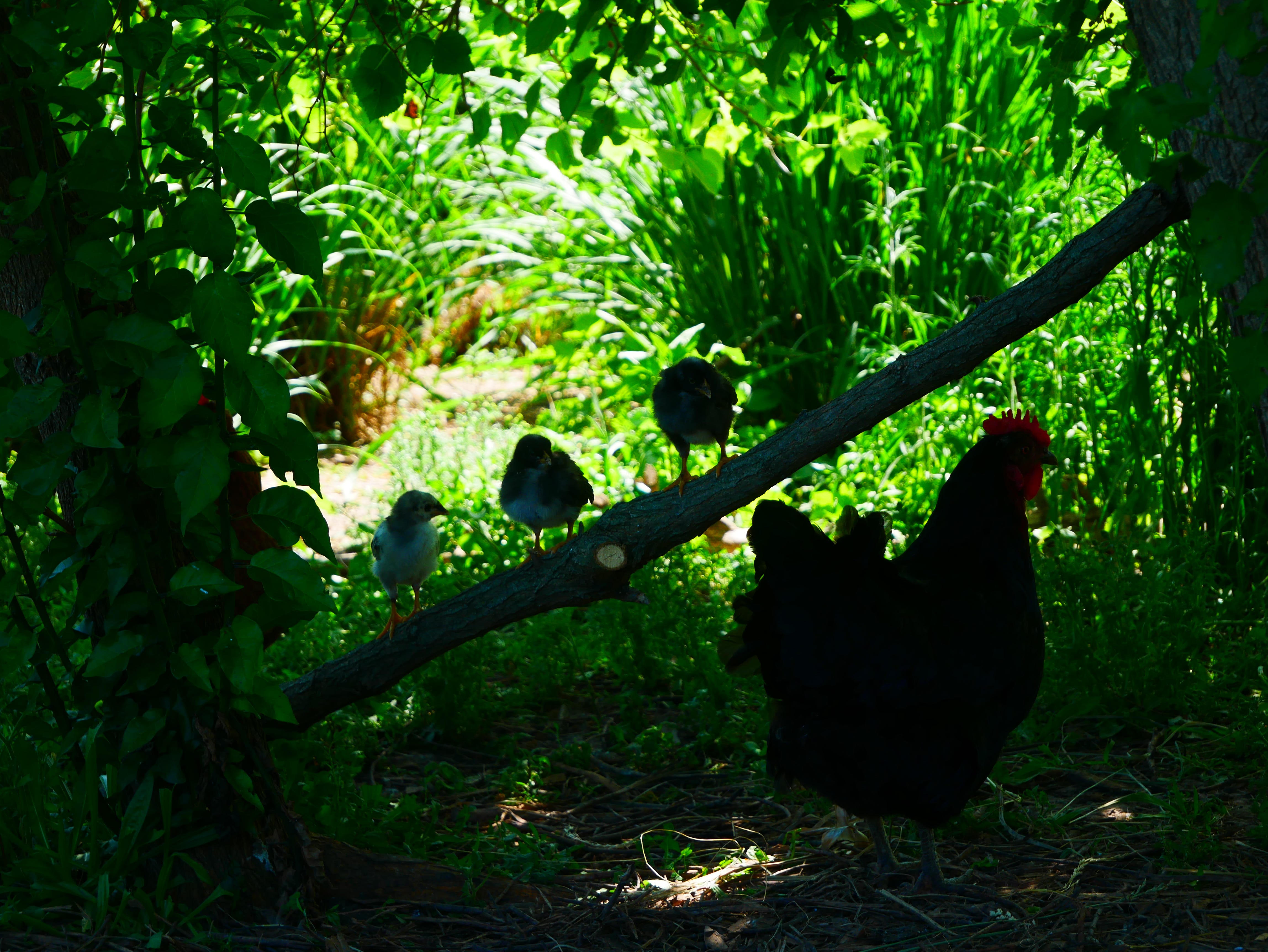
The mulberry trees didn’t fade out with King James’ attempt at sericulture. They stretched, and shat seed and frass, and hummed with birds and flybuzz through the Little Ice Age, the end of slavery, and every subsequent state government plan to eradicate its spread. They sprouted along once newly built farm fence, rising in the wake of slain oaks and extirpated chestnuts, their orange roots coveting the wasted soils of agricultural extraction.
Today, the mulberry’s hunger for degraded land is not yet sated, and there’s lots of it to bite into. Morus alba co-mingles with our native rubra. Male mulberries eject their pollen at half the speed of sound—the quickest biological movement on earth. The tree is nothing if not persistent. Even in matters of gender, the mulberry is untidy. On occasion, mulberries will change genders and either begin fruiting or producing pollen, switching teams to maintain a balanced population in any given location. Normal ain’t natural.
One of my earliest memories of mulberries was when a stately, formerly male street tree in my childhood neighborhood did just this, and began to bloom, later in life. The man my mother was married to at the time possessed a hot anger and complete hatred for untidiness. My natural disorganization was not tolerated, but there was nothing he could do about the purple grackle-shit that was suddenly, regularly deposited on the impractical two-door Mitsubishi sports car he spent weekends detailing. For fifteen years, we were chopped down by his cruelty, plowed under by his oppression, but he could not control what the trees were doing.
I’ve spent more years up here with the mulberries than I ever did in that situation now. I don’t think about him much, and I don’t have the time to concern myself with the past. But maybe I still have some light staining.
The mulberry’s tendency to sprout and resprout keeps it present in the landscape, even where deer predation is high. After some years of deer browsing, the tree will take on a rugged, weathered form, but it won’t die. When it manages to fruit under these conditions, the berries appear low down in a place easy for swine, poultry, children, and wildlife to reach. Furthermore, many early-blooming fruits in Northeast Missouri get nipped by late frosts. The mulberry flowers late, and even if hit by a late freeze, it will often try again, and succeed.
Some folks are not fond of the fruit for aesthetic or cleanliness purposes. It is messy, and overhanging fruit-laden branches, replete with feasting birds, can be the bane of existence for that strange class of people who like to keep their sidewalks clean and lead shitless lives. Personally, I am filled with a rare, pure joy at the thought of fat purple sparrow droppings splatting upon the immaculate driveways, vehicles, and heads of those who might disparage this tree for its untidiness. O berry-filled birds of suburbia, take flight and dispense your dark, sticky sugar upon the properties of that kempt and antiseptic class!
The fruit drops when it is dead ripe. The first sign of mulberry season in your area may well be the purplish leavings of ’possums, raccoons, and other opportunistic climbers. As a very delicate berry, they often fall with a hearty splat, rendering some unsuitable for harvest. I have a technique for harvesting that begins with a large, home-fabricated wooden crook, about eight to ten feet long, padded to protect the bark. I then take a dedicated bedsheet, stapled between two sticks, and hold it beneath the limbs. I shake the branch with the crook and catch your quarry upon the sheet, rolling the ends so the berries naturally roll inward. A lot of other stuff falls along with them: dead twigs, leaves, orchard spiders, and long, thin, brown beetles.
Once collected, the berries are cleaned in batches. I nest a colander within a large bowl full of cool water. With the water level well above the berries, the twigs, bugs, frass, and underripe fruit all float to the top to be skimmed off. Using these techniques, I am able to produce about 8.5 pounds of good eating berries in under four hours, including scything down all the poison ivy around the trees.
Children, like chickens, don’t harvest with strategy, efficiency, or food safety in mind. They laze in the shade and eat, their feet blooming with maroon stains, their chins streaked lavender, watching for sugar rain. As adult humans, we are increasingly exhorted to “know where our food comes from.” But we rarely want to step in it. We want it clean, packaged, and comprehensible. But somehow, standing on this slope, I’d rather be like the fat sparrows and greedy hens—sated, messy, and caught in the beautiful, crude friction of survival without the dreadful knowledge of future scenarios.
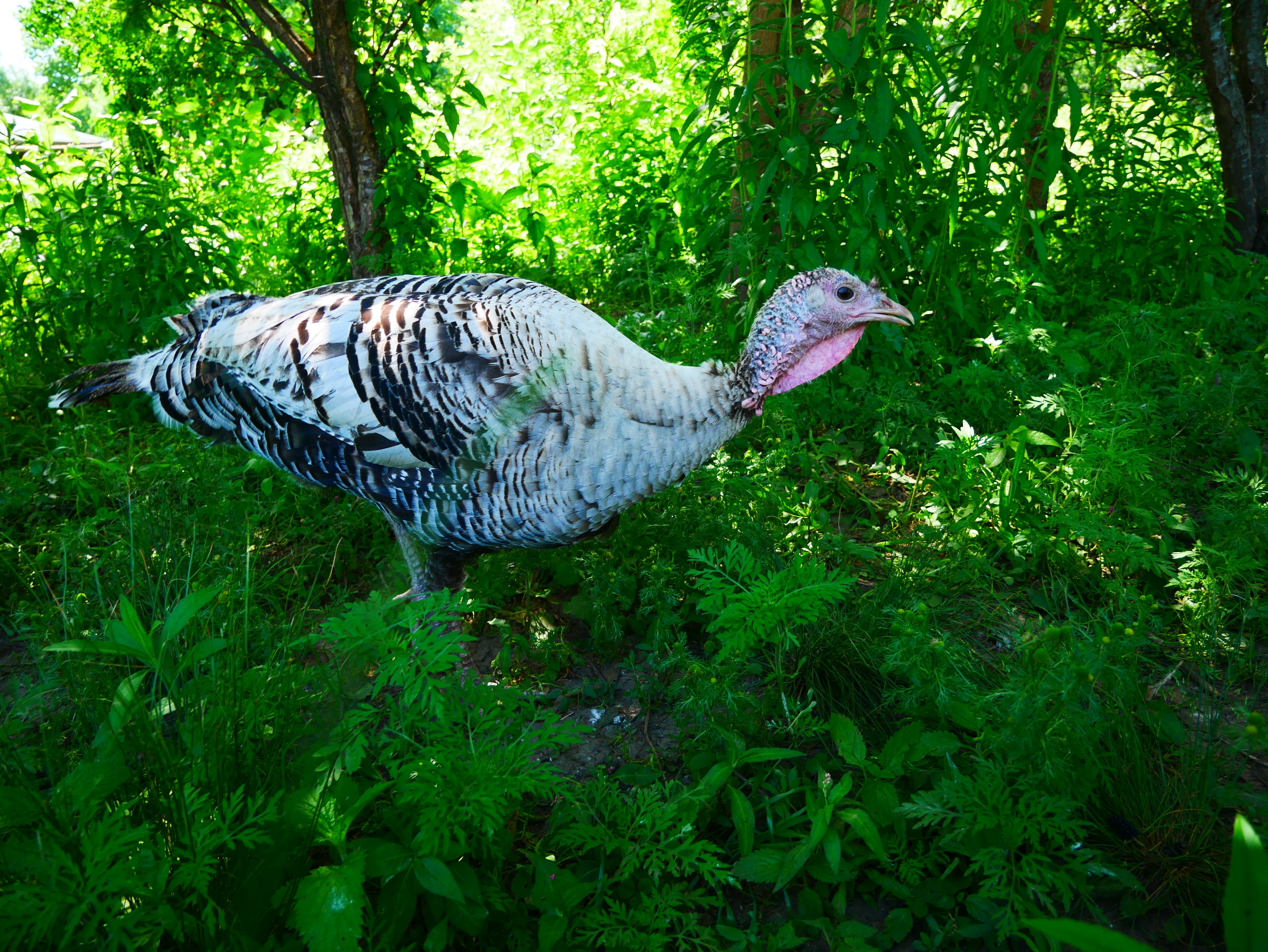
Between the wilting pecans down in the bottomland and the shining, buzzing mulberries spanning the hilltop, is the slope we are farming. It straddles some place between the abundant present and the uncertain future; a burnt-out, clay-stricken, wind-battered hillside that wears the scars of depletion. But the mulberry stands here, undepleted, ready to offer a fecund crop, birdshit and all.
I’ve never been tidy, and I’ve never had a sense of order, cleanliness or organization beat into me successfully. The kids are tracking berry prints into the house. The slugs are having an orgy out in the middens of sugar and shit. I think I’m done cleaning up for this field day, let them step in it. And let them eat until their faces are stained; the heat really brings out the sweetness.
Author’s Note: This piece features a passage from an earlier piece on mulberries, from some years ago. Long time readers may recognize this. I’m not making a regular plan to revise older work, but between farm responsibilities, community responsibilities, and work responsibilities I felt like it was fine to revisit, with the ever-shifting perspectives afforded to me as a dynamic human being with lots of work to do. I actually wrote this as a homework assignment for a “food writing” class I’m currently engaged in, and between planning for my upcoming field day and coping with a serious lack of rain, I figured you, gentle reader, would allow me to be resourceful in these long days somehow full to the brim.
Yours in shit and sugar,
BB
The Fox Holler Almanac is a reader-supported publication— I couldn’t do it without you! Share or leave a comment if you liked it. Hell, leave a comment if you didn’t, though I might ignore it. And if you feel moved and able to materially support my work, upgrade your subscription or buy me a coffee.
Thanks, y’all.
Cheers to shit and sugar! Great piece, as always.
Ok now we want to know how you ate 8.5 lbs of mulberries before they went bad. Or did you freeze them? Please advise.