
The Terms and Services of a Dog-Hair Thicket
Blood contracts, basal area factors, and blackberries

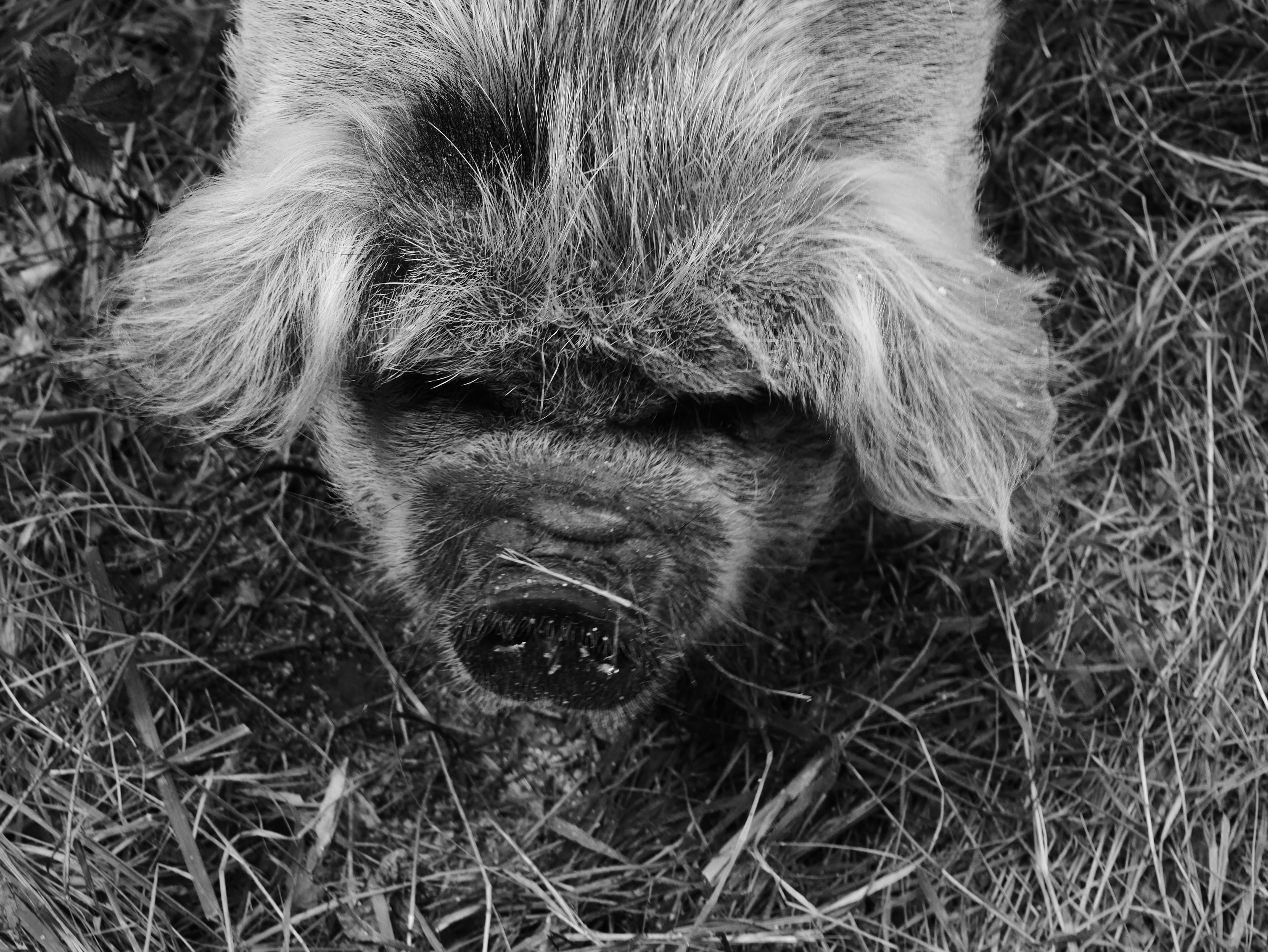
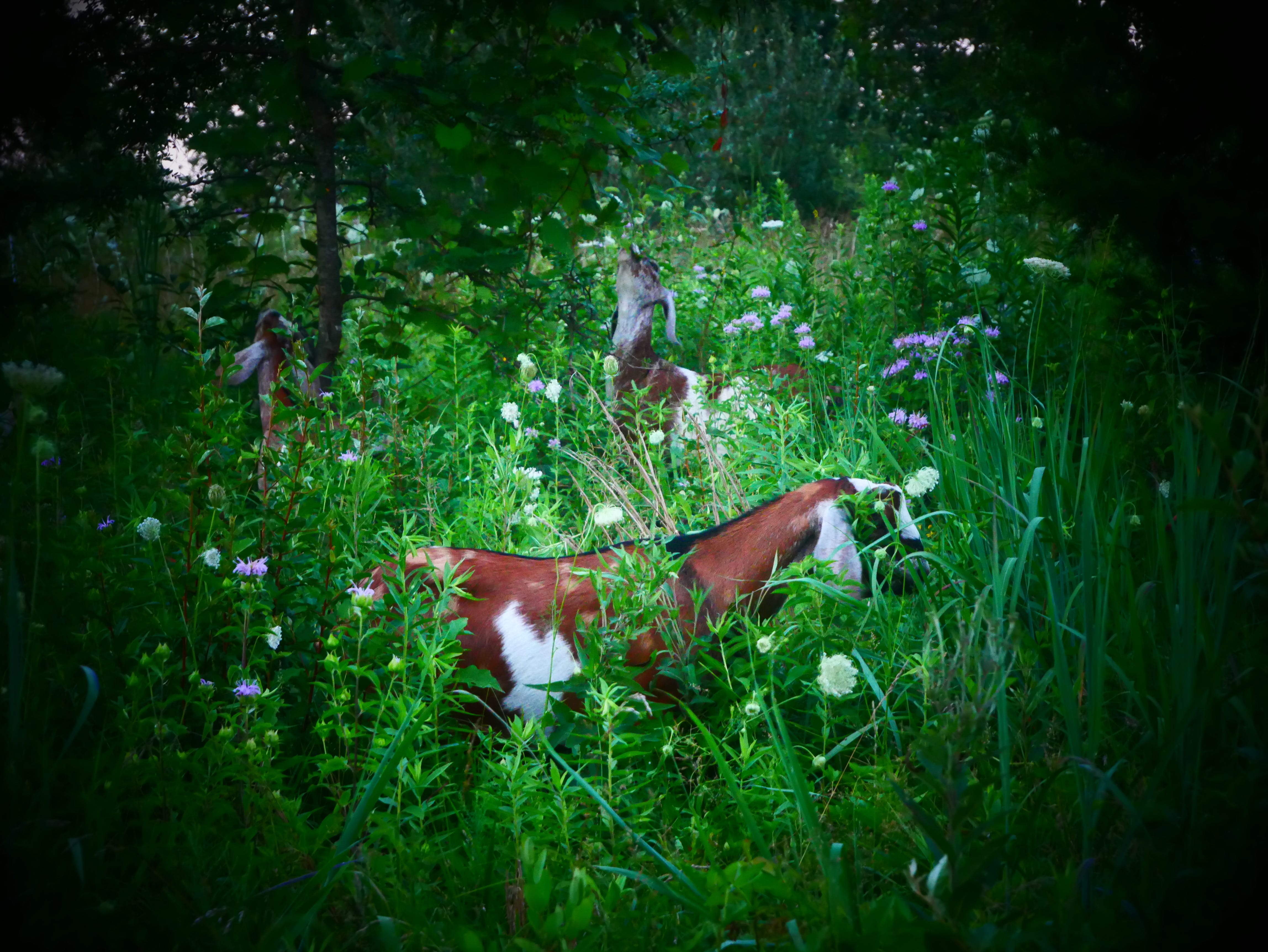
At six in the morning, I have already sweated through my shirt, now stained with the blood of blackberries that I pick on my walk down to the pigs. This is my regular mid-July breakfast; a handful of plucked fruit, given in exchange for the occasional lashing of thorns. My hat, too, is stained bloody from ducking through the low-growth of ripening elderberries that, like a parasol, shelter our growing crop of ducklings from the sunrise heat. Each morning, I feed myself just a bit from the spiny thicket over across from where our male goats are browsing down autumn olive to stripped bones. There are few things finer than watching the bucks and wethers lay waste to autumn olive, their musky scent stirred with the spice of blooming monarda, and a sweet, seedy mouthful of bramble-fruit shoveled in by my sweaty, scraped-up hands; a fine breakfast exchanged for a bit of my own iron and salt.
They say the days are growing shorter, now that the solstice lies behind us by nearly a month, and this may be technically true, in terms of daylight. As an early riser, waking in the humid din of another morning, the pressure-cooker lid of a heat dome already steaming me in my own juices, as a person who must somehow stay awake and productive until the sun sets, and the pullets can be closed in their coops, and the working dogs can be fed their kibble, I am here to report that the days are still much too damn long. A bit under 15 hours, they say, if you don’t count those unending minutes when the sun still burns just below the horizon, its heat mixing with the stillness of trapped and motionless air.
As I begin to write this, July 15th, it is St. Swithin’s Day, one of many days in British weather lore which are claimed to portend the future. A folk proverb states that the next forty days of precipitation is determined by today’s conditions.
St Swithin’s day if thou dost rain
For forty days it will remain
St Swithin’s day if thou be fair
For forty days ‘twill rain nae mare
Unfortunate news, if true. While 500-year floods drown Texas, as campers seek shelter from the inundation of unbound water in the crowns of trees further south in my own state, and Canadian brimstone clouds the air in this continent’s northern reaches, the current conditions here in the dissected till-plains of Northeast Missouri would be untenable, were they to last so long. The soil is quickly drying, the clay shrinking and cracking, all while the air licks at me like dog’s breath. Forty days of this would kill most crops, wilt entire bottomlands, and dry the creeks down to shattered mud. Forty days of this would drive men mad. It seems improbable, but not impossible, anymore.
By lunchtime, the cicadas have resumed their cacophonous hiss, rounds and reels of clicks and screams that vibrate out from the pin oak draws until the air is entirely drowned in song. The pullets dart through stands of sunflower and thickening swards of gama grass to peck up the twitching leavings of this brood as it dies off in successive waves–the uneventful finale of a short life spent screaming, eating, and fornicating, little more than a thin stratum of chitin upon the parched ground.
Down below the pond dam of our swimming hole, through the thick screams of cicadas, there is a low grumble, a wheezing snore, punctuated with shrieks of hot anger—my pigs have once again tipped their trough to construct a wallow, and are now arguing over who gets to roll in the bowl of mud first. Hogs do not have sweat glands. To stay alive under conditions like these, they must slick themselves in cool mud. As a caretaker to pigs, it is part of my job to provide the materials needed to create these wallows, along with clean drinking water. In addition, I need to balance the pigs’ need for soil disturbance with the wider project of stewarding and maintaining the integrity of our sensitive ecosystem. It isn’t easy.
I have been pasturing pigs, in some form, for over a decade now. It has never made much sense to do so. In as far as I demonstrate a land ethic, it has always been that our systems of feeding each other should resemble our native ecology enough so that humans can thrive alongside at-risk habitats. This is why I raise turkeys that fatten on oak-savanna, or manage cattle in an approximate manner to bison, or coordinate goat-browsing as an analog to the elk, now extirpated from the Midwest. Swine have no place in a well-balanced prairie/savanna ecosystem. But then again, this place is not in balance, and has not been for a long time.
So pigs might not make any sense, from a purely ecological standpoint. It turns out the same is true in terms of economics—at least if you are to raise them with any modicum of sustainability or humaneness in mind. And even industrialized swine production only seems to enrich a handful of corporations, not the farmers themselves. I began raising pastured pork because pigs are efficient converters of things we cannot eat as humans into things we can eat. The pig itself is like a battery, storing photosynthetic energy in its flesh, performing a sort of alchemy for human survival in temperate climates where essential fats can be difficult to obtain.
Unfortunately, for the time involved in raising pastured pigs, I’ve never done more than break even and feed my family, on the economic front. As explored in earlier editions of the Almanac, I’ve largely been unwilling to transport my pigs off-site for slaughter—I refuse to outsource their killing. What most folks say about pigs is true: they are intellectual, emotional beasts, but they cannot grant you consent to be killed. Raising pigs does not make sense to me, ecologically, economically, or ethically. But I’ve found some workarounds to that. Managed with the utmost degree of care and observation, a small herd of pigs are tireless partners in the struggle to manage land—let loose as part of some economic scheme, they are one of the worst things humans can do to an intact ecosystem.
I began pasturing pigs in the woods in order to market them as acorn-finished. It made sense to me to do so, as a perennial crop of acorns doesn’t require the degree of intensive resources to produce as the grain needed to finish out pork at a marketable rate. In Britain, this practice of turning hogs loose in a wood to fatten on mast crops like acorns and chestnuts was called pannage (I wrote a bit about it years back in the Almanac). I tried to manage it carefully by keeping the hogs out when soils were wet and vulnerable, but learned at some point what should have been obvious—if I am using acorns to fatten hogs, other animal populations may suffer. An oak has a distinct rhythm of masting. Some years it produces, and other years it does not. This alternating production creates a boom/bust cycle in the oak’s seed predators. For example, squirrel litters increase in size on account of the widely available nutrition during a mast year, but the acorn population drops the following year, which then reduces the squirrel population. This nutritional balancing act helps to allow for adequate oak seed to remain undisturbed in the seed bank for future oak regeneration.
When my pigs eat all the acorns, I’ve observed squirrels resort to stripping tree bark to access sugars in the sap, after they’ve scoured the duff for stray seed. This is a break in the cycle, leading to a cascade of fewer squirrels and fewer oaks, plus significant tree damage. If practiced year after year, the woods we have would gradually decline or at least shift to a different composition—probably more autumn olive.
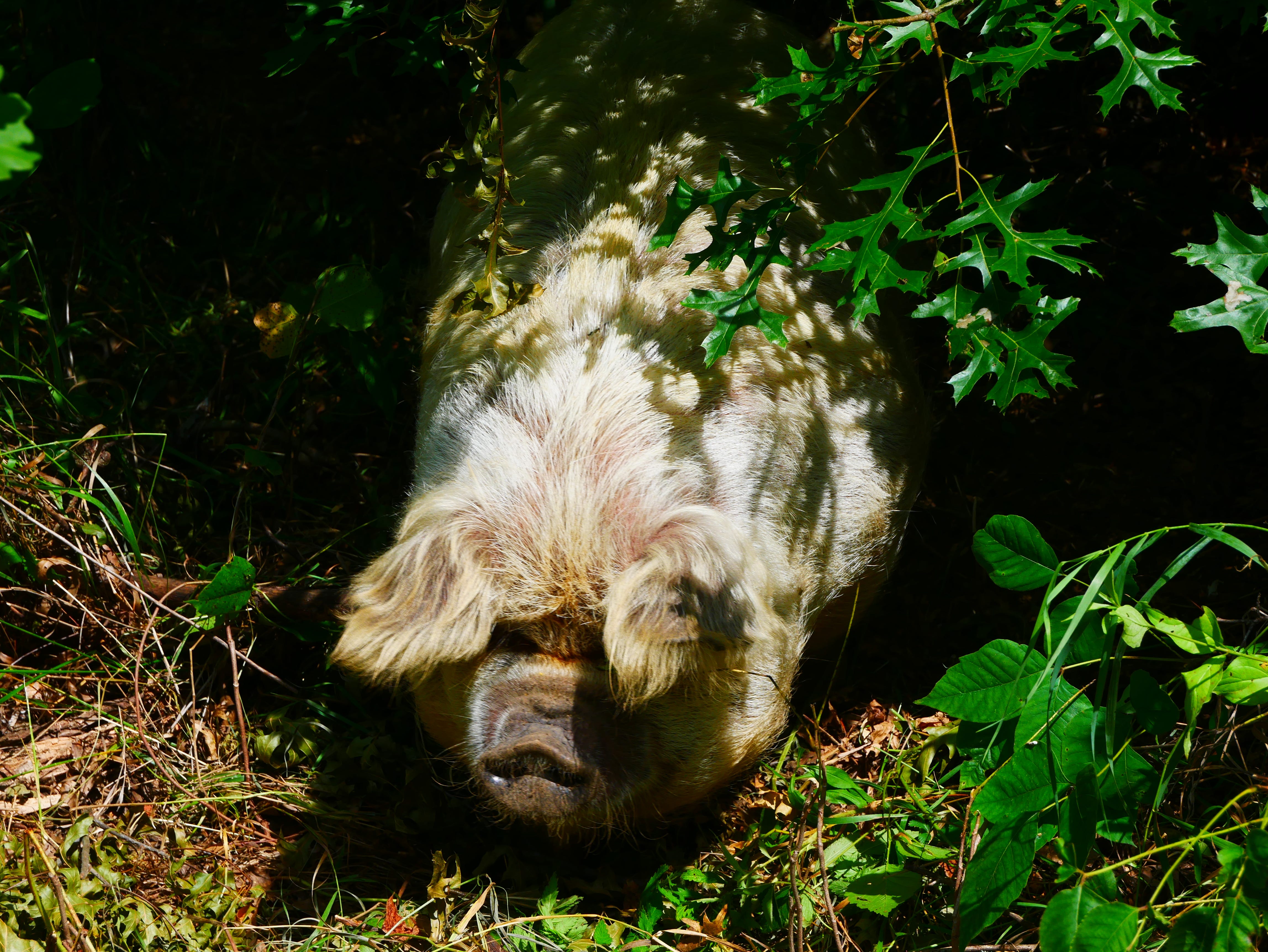
Beyond pannage, I raise pigs under trees because they thrive in a wooded setting, and they need the shade more than most livestock. Today, industrial hogs—for all their mistreatment—exist in climate-controlled barns, partly because they would simply perish in an open field. For a pig to survive outside, it needs cover from the sun and shelter from harsh winter conditions, something trees provide more efficiently than any portable structure.
But when I decided to stop raising pork, I didn’t stop raising pigs. I still have four older, retired sows and a father/son duo of boars that I pasture separately, all of whom are impractical to harvest for meat at their age. Some of my sows are the same age as my own son, and in that strange softness that increases with my own age, I’ve built too tight of a connection to cull them or sell them off to anywhere other than the pig paradise they’ve known. The result has been that I must find them meaningful employment—consuming surplus produce and dairy, cleaning up the orchard floor after harvesting, assisting in the rapid cycling of solar energy into soil carbon, and most notably, managing degraded woods and savannas for “problematic generalist species.”
In the still and wilted understory of dying elms, waist-high brambles clawing at my salt-rimed pants, I roll a wheelbarrow with two sloshing buckets of water over stumps and thorns. Through the shrieking rounds of cicada song, I am greeted with muffled grunts. I am here to fulfill a contract with the swine. While no animal can consent to its death at my hands, I can certainly fulfill a contract in their best interest. The contract was once simple—that in exchange for their flesh, for the flesh of their young, I would provide the fullest and most humane life I could. But for these remaining hogs, the contract has deepened. In the unrelenting heat of the summer’s worst days to be alive, I will carry their water, and provide adequate shelter and care, forever.
I have another contract too, with the prairie and woodlands, and thus far I’ve fulfilled it to the best of my ability. I will only direct these pigs’ potential for disturbance towards places where it will only help to restore balance—thickets of autumn olive, patches of sericea lespedeza, areas where the invasive undergrowth of honeysuckle and multi-flora rose have choked out the at-risk native flora, and all that relies on it. These contracts are very much written in blood—the blood of pigs, and my own blood. Financial compensation is not guaranteed, and indeed unlikely.

It works like this: I carefully coordinate the movements of exotic animals to keep the movements of exotic plants in check. I do this as the type of human who is largely exotic to this continent, at least in the longer scheme of things. First, I prescribe pig management to a parcel of land. It must be durable enough to withstand their wallowing, their heavy bodies, their sharp hooves, and their ceaseless appetites. It must be vegetated thickly. The first blood is shed when I set out to carve the boundaries of their space into the landscape, moving through thorny hedges with my brush scythe, my loppers, and my ax. Drop by drop, the thorns and ticks and mosquitoes take their tax from my body. Hacking through the brambles and poison ivy, I gather a deeper lay of the land, first by looking down.
If I come across any plants that only thrive in sensitive soils, mycorrhizal obligates like prairie orchids and mayapples, I avoid the area. Same thing if I can place an open hand on the ground and not touch living cover. Most of these areas are rather carpeted with poison ivy, in which case I do not perform the hand test. If the soil slips under my boot, the site is too wet to safely stock with pigs.
Then, I look straight ahead for signs of earlier human disturbance: ancient fenceposts, old, girdled trunks, corroding heaps of wire, invasive woody growth and “pioneer” tree species—the wounds of disturbance. With these clues, I can choose if and how to aid in the next cycle of ecological succession, but in general, remnant fencing seems to inherently point to unnatural degradation. Sometimes, I use a forester’s cruising stick or prism to get a quick basal area measurement of timber in the potential paddock. While primarily an economic decision-making tool that can be used to quantify tree density into board feet, and hence, US dollars, basal area measurements also give us a peek into how well the woods support biodiversity.
Anything with a basal area factor of under 40 has high potential, particularly as prairie savanna—lots of sunlight allowing for a diversity of grasses, forbs and sedges. These are my priority areas for invasive removal, because they are so good at taking advantage of these conditions. If the trees are thick-barked enough, I might consider fire-management instead of pasturing and browsing, as a full grazing cycle might remove the necessary fuel for a hot burn. Or, the pigs, the goats, and I will take turns: the pigs knock down the thick brush to allow me access to the offending woody plants, I chop them down and chip them up, cycling carbon back into the soil, and the goats pass through to browse on resprouts. A year of this practice keeps the plants in check—three years seems to have a considerable impact on them.
Woods with a basal area factor between 50 and 80 are more or less at a sweet spot, a dynamic, healthy stock of trees that allows enough light through the canopy for regeneration, but is closed enough to disadvantage invasive plants. If I find a few in these areas, I hack them out by hand—I don’t let hogs loose in these structurally diverse, healthy areas. Factors between 90 and 110 are often home to shade-tolerant understory plants, but regeneration, particularly of oaks, begins to drop off. I might harvest a bit of timber or firewood in here, creating oases of sun, which then can be kept free of opportunistic exotic plants through managed goat browsing. There’s not much for livestock to glean in these areas, regardless of my management objectives, and they’re largely best left alone.
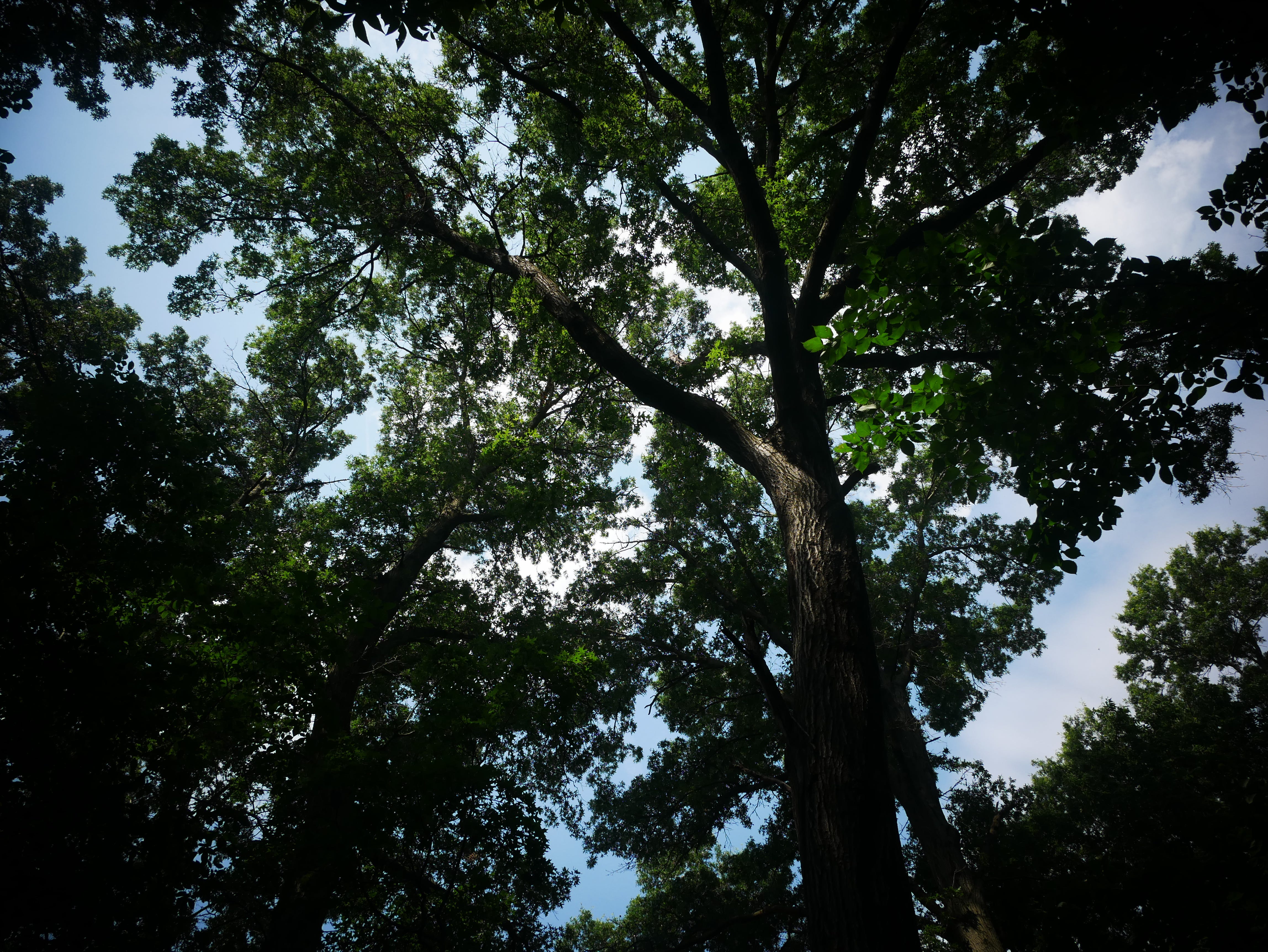
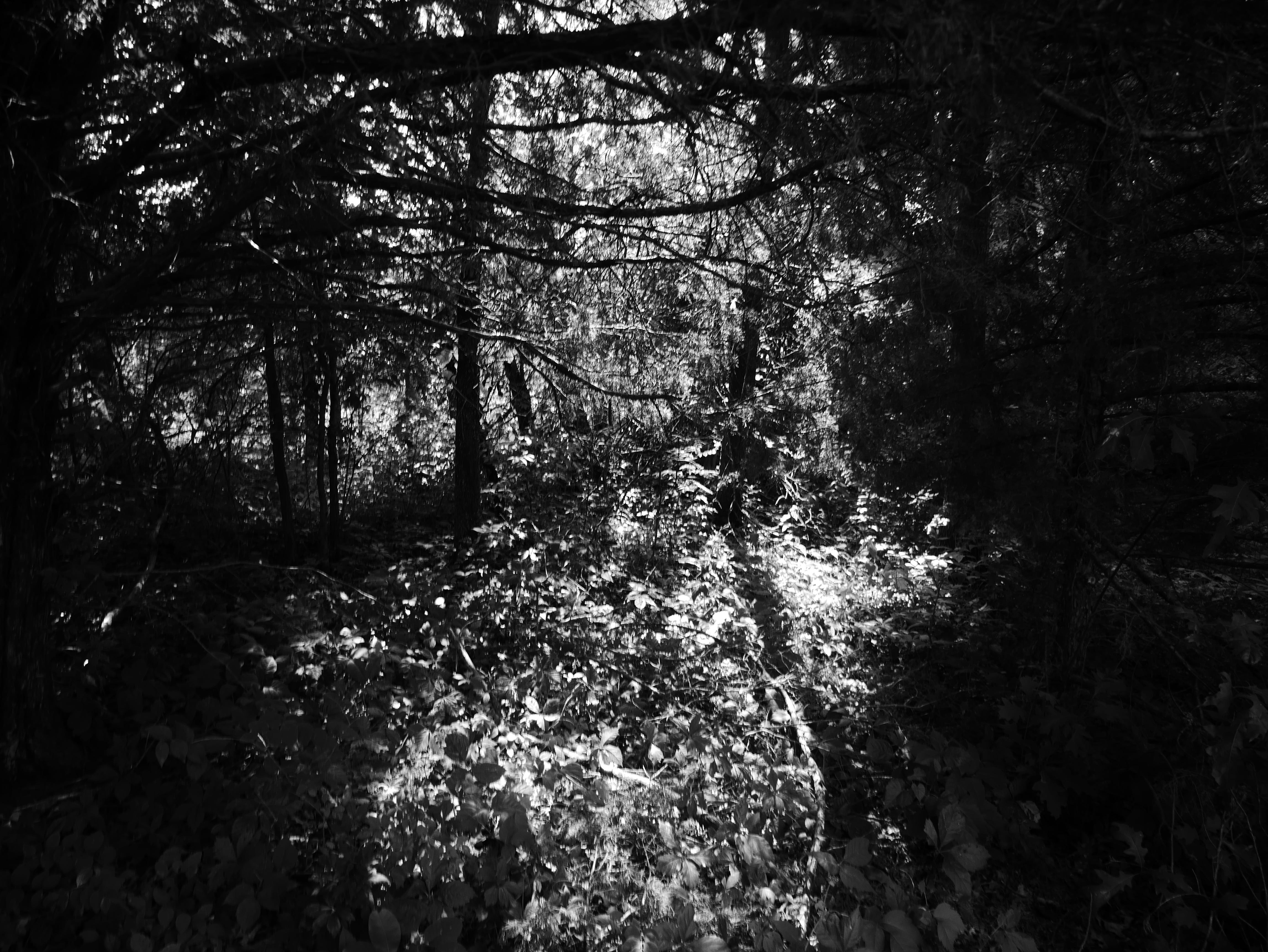
Then, there’s the overstocked woodlands—dog-hair thickets of elm, maple, and pin oak with a basal area factor of 110 and above. These are some of the hardest places to manage, in terms of getting my ass whooped by the woods, but they are necessary to steward, and I did, after all, sign a contract. They take their blood for sure, and if I’m not being attentive enough, they might even knock a tooth loose. Without sunlight, the understory diversity in these areas collapses. Here again, I apply the triple-whammy of hitting with pigs, saws, and goats. Repeated winter seedings of native cover are also a nice way to allow for diversity.
Finally, I look up, sometimes with the aid of a canopy densiometer—a tool used for quickly gathering canopy cover measurements. In terms of “regenerative agriculture,” canopy cover of 20-30%, combined with grasses, provides the highest level of photosynthetic surface in a temperate climate. With management-intensive grazing, that means a higher-level of carbon sequestration. Notably, this degree of canopy cover is similar to the prairie savanna ecosystem that Northeast Missouri was primarily composed of, before European settlement put an end to Indigenous stewardship, which would have included occasional fire and heavy game pressure (an analog to management-intensive grazing). Also, while looking up, I make note of healthy or unhealthy foliage.
All these observations combine to help me decide on a management plan for the area. Even with all the tools and formulas at my disposal, I’m still not an expert; this is just what I’ve figured out so far. Despite my seeming rootedness to this place, I still consider myself very much foreign here—a member of an exotic human sub-group, managing exotic livestock, against exotic plants.
This, perhaps, is the ultimate workaround. I can’t just hit rewind on two hundred years of extraction, extirpation, and extinction by raising pork in a novel, sustainable manner. I can’t pretend my British-origin dairy cows are bison, or mend the broken baseline of this continent’s ecology. I can’t claim to regenerate anything; not soil carbon, nor passenger pigeons, nor entire groups of people who were marched down bloody trails to make way for this farm. All I can do is make good on the contract. So I bear the brunt of thorns, carrying my weight across the unmanaged wilderness through my own short, screaming, eating, fornicating existence, until my own thin stratum of microplastics and mined wire and silicon chips fades into the deepening horizon of the soil. I have but a brief time to make good on my word, so brief in comparison with the life of a forest, or a prairie.
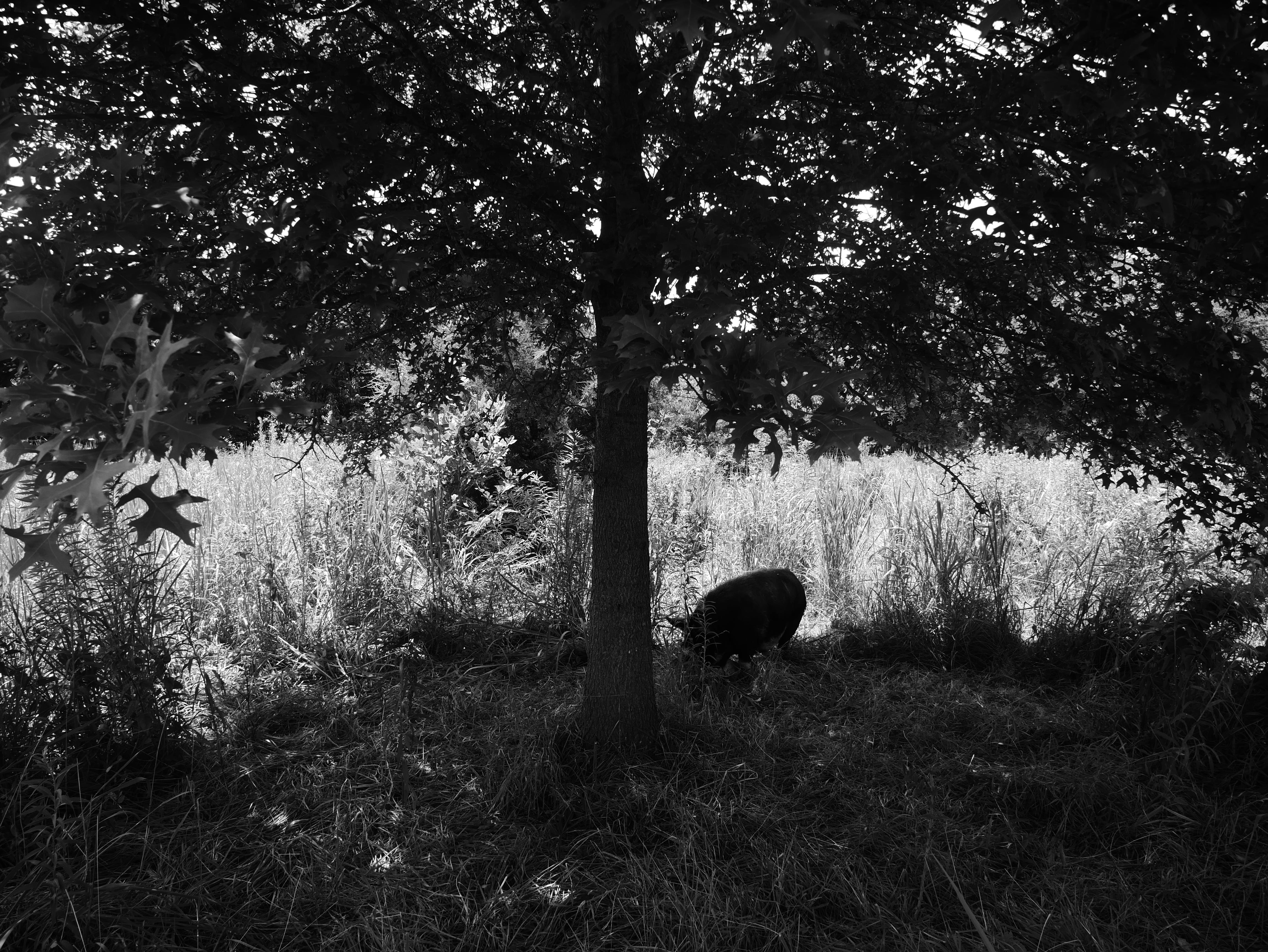
If this heat remains for forty days, we’re doomed—let alone forty years, or decades, or centuries. And I’ll admit, the idea of it makes it pretty unmotivating to spend my remaining days hacking down autumn olive. Maybe I should have read the fine print.
Rainless clouds pass before a sun that stubbornly lies on the horizon, unmoving. It doesn’t seem like it now, but things will change. For better or worse, they necessarily must. With the hogs in their new paddock, nibbling wild grape, rolling in their wallow—the terms and services of a dog-hair thicket written into my skin with briar scratches and briny filth—I observe the canopy stir slightly, watching for rain in the distance. The pigs are nestling in for a humid night in their new home, constructing soft nests of cut branches and grass thatch. And displaced from our old world context, we continue the work of building our home here.
I would be unable to create this work without the material support of readers like y’all! If this essay connected with you in a meaningful way, consider upgrading your subscription, or express your gratitude with a one-time tip. Thanks for reading!
A few author’s notes: This piece is thematically related to the most recent Almanac entry—might be worth a look for deeper context. Furthermore, I discussed autumn olive and invasive species about this time last year, and I thought it was a nuanced take, in case anyone wants to throw down about that thorny subject. Finally, enough linking to my own project… I wanted to share a new publication in the ecology-focused almanac subgenre of Substack, written by an actually ecologist who I know and trust, not just a pig-herding curmudgeon. Please check out the first edition of Zack Miller’s The Ecologist’s Almanac, I just did, and I thoroughly appreciated the read!
Thanks for looking.